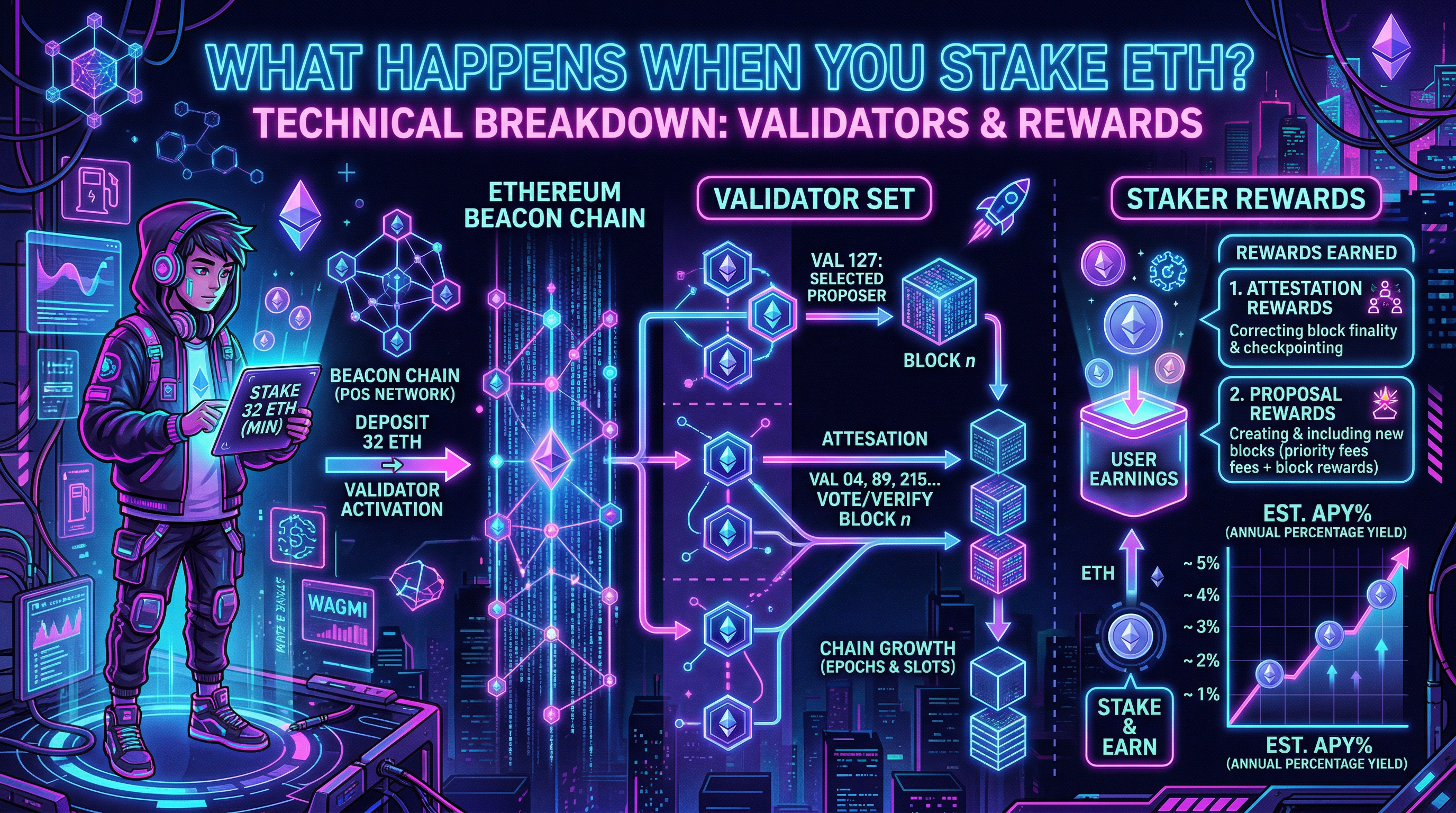
Most staking guides tell you "deposit ETH, earn 4% APY." That's the kindergarten version. What's actually happening when your ETH gets staked — the validator activation queue, the attestation process, consensus-layer vs. execution-layer rewards, slashing conditions, withdrawal mechanics — is a fascinating system that directly impacts your returns, risks, and strategy. After staking 64 ETH across four validators since 2021, here's the technical breakdown I wish I had on day one.
Understanding Ethereum staking at a technical level isn't just for developers. It directly informs when to stake, how to stake, what risks you're actually taking, and why certain yield strategies work the way they do. This is the deep dive.
How Ethereum's Proof-of-Stake Actually Works
Ethereum switched from Proof-of-Work (PoW) to Proof-of-Stake (PoS) in September 2022 ("The Merge"). Post-merge, Ethereum's security comes from validators who have each locked up 32 ETH as economic stake. Here's the mechanics:
The Validator Lifecycle
To become a validator, you deposit 32 ETH into Ethereum's deposit contract. Your deposit enters the activation queue — a line of pending validators waiting to be activated. During peak demand periods (like the EigenLayer restaking wave of 2024), this queue can hold tens of thousands of validators, meaning months of waiting. Post-Shanghai, this queue has been managed, but during periods of high staking demand, waiting periods of 2–8 weeks are realistic.
Once activated, your validator is assigned to a "committee" — a random group of validators responsible for attesting to block validity. Every epoch (6.4 minutes), validators attest to the head of the chain. This is the bread-and-butter job of a validator: attend to the network, vote on blocks, keep the chain advancing.
Consensus Layer vs. Execution Layer Rewards
Ethereum staking has two distinct reward streams:
- Consensus layer rewards: The protocol-issued ETH rewards for attestations and block proposals. This is the "base staking yield" — approximately 3–4.5% APY as of 2026, funded by new ETH issuance.
- Execution layer rewards: Priority fees (the tip users pay for faster transaction inclusion) + MEV (maximal extractable value from block ordering). These go directly to validators who propose blocks. In high-activity periods, execution layer rewards can significantly exceed consensus layer rewards.
The MEV component of staking yield is real and significant. Validators using MEV-Boost (which virtually all do) earn 20–40% more than validators without MEV optimization. The "best performing" validators on any given day are typically those that got lucky in being assigned to propose a block during a high-MEV period (like a large NFT drop or a major DeFi liquidation event). This luck-based variance is why single-validator staking returns fluctuate significantly month-to-month.
Solo Staking vs. Liquid Staking vs. Staking-as-a-Service
Solo Staking (Maximum Control, Maximum Responsibility)
Run your own validator with 32 ETH and your own hardware. Keep 100% of rewards (no operator fee). Full self-sovereignty. Requirements: constant uptime (offline validators get penalized), secure key management (validator keys AND withdrawal keys must be secured separately), and technical competence to run the validator client software (Prysm, Lighthouse, Teku, or Nimbus).
The software stack: execution client (Geth, Nethermind, Besu) + consensus client (Prysm, Lighthouse) running 24/7 on dedicated hardware (minimum 16GB RAM, 2TB fast SSD, stable internet). The minimum hardware investment: $500–800 for a NUC-style mini PC. Total setup time: 2–4 hours for a technical person. Annual electricity cost: ~$120–180.
Staking-as-a-Service (SSaS)
Protocols like Allnodes, Rocket Pool's node operator program, and SSV Network let you maintain custody of your keys while delegating the technical operation. You provide 32 ETH and the keys; they provide the uptime and technical management, taking a fee (1–10% of rewards). Best for: people who want the full 32 ETH native staking experience without the technical burden.
Liquid Staking (For Everyone Else)
Lido, Rocket Pool, cbETH — deposit any amount of ETH, receive an LST, maintain full liquidity. Takes the complexity of validator management entirely off your hands. Best for: everyone with less than 32 ETH, and anyone who values simplicity over maximizing validator-level returns.
Trade Crypto Smarter
Traderise gives you multi-asset access, real-time portfolio tracking, and low fees. Built for degens who want an edge.
Try Traderise FreeSlashing: When Your Stake Gets Taken
Slashing is the mechanism by which misbehaving validators lose a portion of their staked ETH. Two slashable offenses:
- Double voting (equivocation): Signing two different blocks at the same slot height. This is the most common slash reason and usually happens by accident when operators run their validator keys on two machines simultaneously (e.g., a backup that wasn't properly deactivated).
- Surround voting: Creating votes that contradict each other in a way that could enable chain reorganization attacks.
The slash penalty: an immediate 1/32 of stake is removed (1 ETH on a 32 ETH validator), followed by a 36-day exit period during which the validator is "off duty" but still subject to small ongoing penalties. If many validators are slashed simultaneously (a "correlation penalty"), the penalties scale up dramatically — up to 100% of stake can be slashed if a third or more of validators are slashed in the same event.
For liquid staking users: Lido and Rocket Pool both carry slashing insurance. Rocket Pool node operators must post RPL collateral that covers potential slashing events. For solo stakers: proper key management (single-use keys, vault-stored withdrawal keys) prevents the vast majority of slash events.
Withdrawal Mechanics Post-Shanghai
Ethereum's Shanghai upgrade in April 2023 enabled two types of withdrawals:
- Partial withdrawals (sweep): Any validator balance above 32 ETH automatically "sweeps" to the withdrawal address in a continuous process. All validators cycle through the sweep roughly every 5 days. Your accumulated rewards are automatically sent to your withdrawal address without any action required.
- Full withdrawals (voluntary exit): You submit an "exit" message signed by your validator key. The validator enters the exit queue. Once processed (currently 1–3 days), your full 32 ETH + rewards are released to your withdrawal address.
The exit queue delay (1–3 days currently) can extend significantly during mass exit events. If a major protocol or slashing event causes many validators to exit simultaneously, the queue can grow to weeks or months. Plan your exit timing accordingly if you anticipate needing liquidity during a market event.
The Yield Calculation: What You Actually Earn
Current ETH staking yield components (April 2026, per validator annually):
- Consensus layer base: ~3.6% APY
- Execution layer priority fees (average): ~0.5% APY
- MEV-Boost earnings (average): ~0.4% APY
- Total: approximately 4.5% APY for a well-run solo validator
Liquid staking returns are slightly lower after operator fees: stETH ~4.1%, rETH ~4.0%, cbETH ~3.3% (Coinbase takes a larger cut).
For tracking your ETH staking yield alongside the rest of your portfolio, Traderise's portfolio dashboard aggregates all your positions — whether you're solo staking, liquid staking through Lido, or holding cbETH — into one clear P&L view.
Make Your ETH Work Harder
Track your ETH staking yields alongside all your crypto positions on Traderise. Get real-time data, low-fee trading, and the multi-asset dashboard serious ETH holders need.
Try Traderise Free