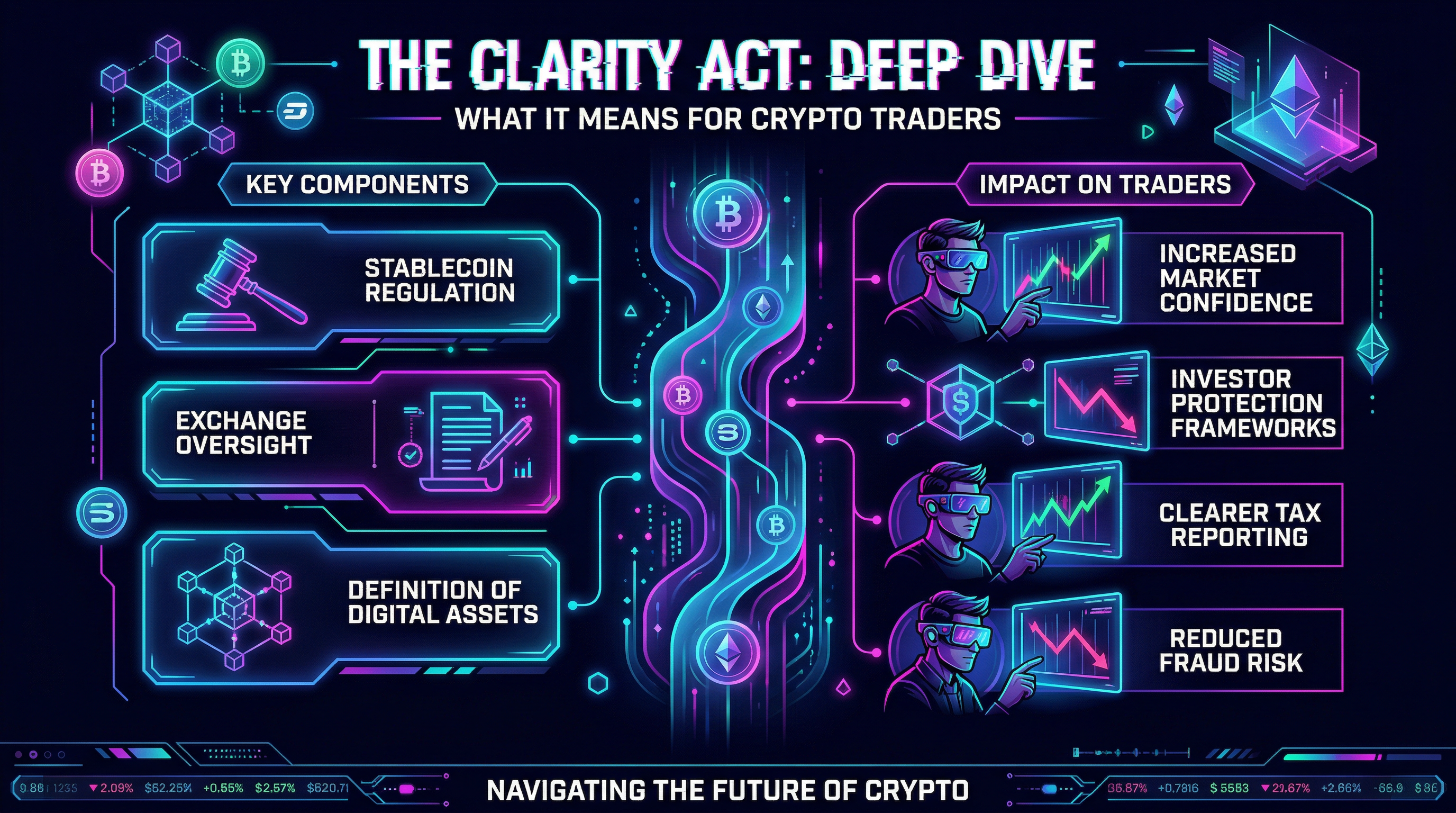
The Crypto Assets and Legislation for Investor Trust and Yield (CLARITY) Act — the most significant US crypto legislation since the Bitcoin ETF approvals — passed in 2025 and went into full effect in 2026. Most crypto Twitter is either "this kills crypto" doomer or "moon incoming" maximalist about it. Both are wrong. The reality is nuanced, significant, and determines how you should be positioning your portfolio right now. Here's the actual breakdown.
I've read the full text (yes, all 247 pages). Here are the provisions that directly affect crypto traders, DeFi users, and anyone holding tokens in the US market.
The BTC and ETH Classification: What It Actually Means
The CLARITY Act explicitly classifies Bitcoin and Ethereum as digital commodities under CFTC jurisdiction, not securities under SEC jurisdiction. This is the most practically important provision for retail holders.
What this means: BTC and ETH are treated like gold or oil — you can buy, sell, hold, and derive yield from them without the "investment contract" (Howey test) concerns that plagued other tokens. Exchanges don't need SEC broker-dealer licenses to offer spot BTC and ETH trading. Miners, validators, and stakers are explicitly not considered securities issuers. The legal clarity this provides for institutional investment in ETH staking products is enormous.
What it doesn't mean: BTC and ETH can still be traded on CFTC-regulated futures markets. Market manipulation rules still apply. Exchanges offering BTC/ETH still need money transmission licenses. The commodity classification does not make crypto entirely unregulated — it just clarifies which regulator (CFTC) has jurisdiction.
The most underappreciated consequence of BTC/ETH commodity classification: it clears the path for ETH staking ETFs. Once ETH is definitively a commodity (not a security), the argument against approving a staking-enabled ETH ETF collapses. Fidelity and BlackRock have both filed for ETH ETF products that include staking yield. If approved, this brings ETH staking yield directly to traditional brokerage accounts — potentially bringing billions in new demand for ETH staking.
What Happens to Altcoins Under CLARITY?
Everything that's NOT Bitcoin or ETH falls into a more complex legal landscape. The CLARITY Act creates a "sufficient decentralization" test: tokens can migrate from security classification to commodity classification if the underlying network is "sufficiently decentralized" — no single entity controls 20%+ of token supply or network governance.
Tokens that clearly pass the decentralization test: Litecoin, Bitcoin Cash, most PoW coins. Ethereum L2 tokens (ARB, OP) are in a gray zone. SOL likely passes but Solana Foundation's significant early token holding is a complicating factor. Most small-cap tokens with identifiable, concentrated development teams will remain in securities territory.
The Exchange Registration Requirements
Under CLARITY, US crypto exchanges must register as either:
- Digital Commodity Exchange (DCE) under CFTC — for exchanges primarily handling commodity tokens (BTC, ETH, and other qualified tokens)
- Digital Asset Securities Exchange (DASE) under SEC — for exchanges handling security tokens
- Or both (most large exchanges are pursuing dual registration)
Practically: Coinbase, Kraken, Gemini, and Robinhood have all initiated registration processes. The new registration requirements increase compliance costs significantly, which has the effect of reducing the number of viable exchanges — good for the survivors (like Traderise, which was built with compliance infrastructure from day one) and potentially devastating for smaller players.
Trade Crypto Smarter
Traderise gives you multi-asset access, real-time portfolio tracking, and low fees. Built for degens who want an edge.
Try Traderise FreeWhat CLARITY Means for DeFi Protocols
The CLARITY Act draws a critical distinction between "self-custodial" DeFi (users control their own keys) and "custodial DeFi" (protocol holds assets in some capacity).
Self-custodial protocols (Uniswap, Aave, MakerDAO as smart contract systems) are NOT classified as exchanges and don't need to register as such. This was a major win for DeFi — the protocols can continue operating as deployed code on public blockchains without requiring exchange licenses.
However, DeFi front-ends (the websites through which users access protocols) face geographic restrictions. Protocols providing interfaces to US users for products that could be classified as unregistered securities must implement geo-blocking. This explains the wave of US-blocking that hit many DeFi protocol front-ends in 2025.
The Tax Reporting Changes: 1099-DA
The CLARITY Act mandated the IRS implement Form 1099-DA for digital asset reporting. Starting 2025 tax year: all custodial platforms must report customer transactions to the IRS directly. Your gains and trade data are already on an IRS server. This applies to Coinbase, Kraken, Binance.US, and all regulated US exchanges.
Non-custodial DeFi transactions are still self-reported — but the IRS is actively developing blockchain analytics capabilities. The noose is tightening on unreported DeFi gains. Get compliant.
How to Position Your Portfolio Under the New Framework
- Prioritize BTC and ETH: Their commodity classification eliminates most regulatory uncertainty. Trade BTC and ETH on Traderise with the confidence of regulatory clarity behind you.
- Screen altcoins for the decentralization test: Before buying, check whether the token project can plausibly pass the sufficient decentralization test. Tokens that can't may face SEC enforcement action and potential delistings.
- Get your 2025 crypto taxes in order now: 1099-DA data is already with the IRS. Use crypto tax software, organize your DeFi transaction history, and file accurately. The risk of non-compliance just got materially higher.
- Watch DeFi governance votes on US geo-blocking: Several DeFi protocols are debating how to implement CLARITY Act compliance. Protocol governance decisions will affect which DeFi opportunities US users can access through 2026–2027.
Trade Crypto the Right Way in 2026
Traderise was built for the regulated crypto era — compliant, secure, and stacked with the features serious traders need. Trade BTC, ETH, and top altcoins with confidence.
Try Traderise Free