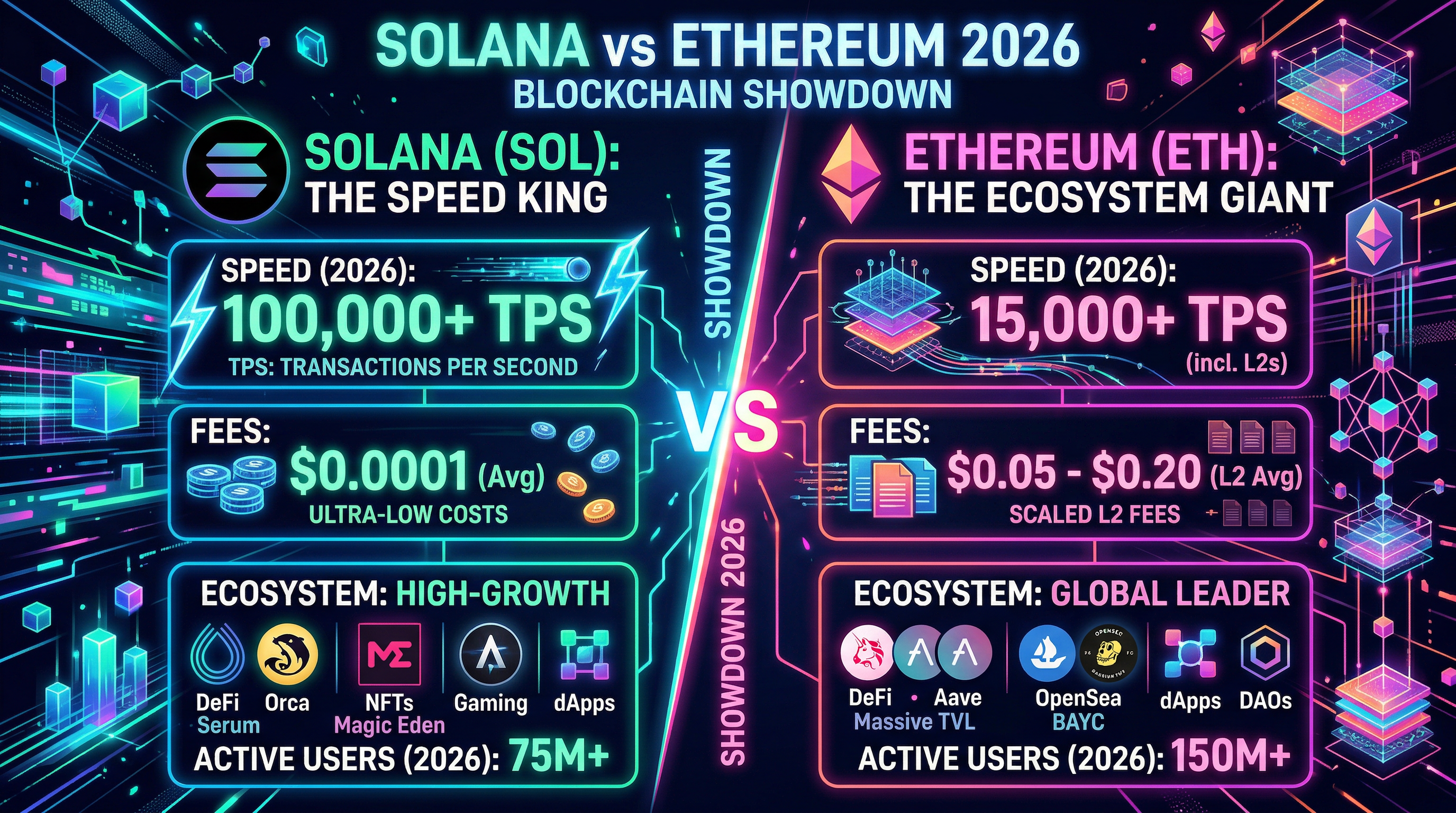
I ran a 90-day experiment in early 2026: equal allocations to Solana and Ethereum L2 ecosystem, tracking every fee paid, every outage, every protocol interaction, and every yield opportunity. The results genuinely surprised me — and they'll challenge what you think you know about both chains. The Solana vs. Ethereum debate has become religious in crypto Twitter, but the actual data paints a more nuanced picture than either maximalist camp admits.
Spoiler: both ecosystems are thriving for very different reasons. But there's a clear winner for specific use cases, and understanding which is which will save you gas fees, opportunity cost, and ideological confusion in 2026.
The Numbers First: Speed, Cost, and Reliability
Transaction Speed: Solana Wins Decisively
Solana's theoretical throughput is 65,000 TPS with 400ms block times. In practice, during Q1 2026, Solana was processing 3,000–6,000 TPS at peak with average finality times of 0.8 seconds. Ethereum L1 processes 15–30 TPS with 12-second slots. Ethereum L2s (Arbitrum, Base) bridge the gap — Arbitrum sees ~250ms soft finality, Base ~2 seconds. But raw Solana speed still wins for applications where sub-second finality is critical (high-frequency trading, real-time gaming, social feeds).
Transaction Fees: Not What You Think
Solana base fees are $0.00025 per transaction — genuinely close to zero. Even with priority fees during congested periods (which Solana introduced in 2023), fees rarely exceed $0.02–0.10 during normal market conditions. During extreme congestion events (like major NFT mints), fees can spike to $0.50–$2.00 — still cheap by Ethereum L1 standards.
Ethereum L2s in 2026, post-EIP-4844: Base and Arbitrum fees run $0.001–$0.05 for most transactions, with complex DeFi interactions ranging $0.05–$0.30. Ethereum L1 for complex DeFi: $5–$50 depending on congestion. The honest comparison is Solana vs. Ethereum L2s, not Solana vs. L1. On that comparison, Solana is cheaper by ~3-10x for most transaction types.
Reliability: The Elephant in the Room
Solana has had 12+ significant network outages or major degradations since launch — including multiple full network restarts. In Q1 2026, Solana experienced one significant congestion event that caused transaction failure rates above 50% for ~4 hours. Ethereum has not had a full network outage since the merge. For applications where uptime is mission-critical (DeFi liquidations, high-value trades), Ethereum's reliability advantage is real and meaningful.
Solana's congestion issues are largely being addressed by QUIC protocol improvements and local fee markets. The 2025 Firedancer validator client by Jump Crypto is a complete rewrite of the Solana validator in C++ with dramatically better performance under load. Once Firedancer is fully deployed, the reliability concerns should decrease substantially. The performance gap vs. Ethereum L2s will widen further.
DeFi Ecosystems: Where Are the Real Opportunities?
Solana DeFi: Fast, Cheap, and Increasingly Liquid
Jupiter Exchange has become the dominant DEX aggregator on Solana, processing over $3B in monthly volume in Q1 2026. Marinade Finance and Jito are the leading liquid staking protocols with ~$4.5B combined TVL. Kamino Finance (lending/borrowing) has grown to $2B+ TVL. Drift Protocol for perps is legitimately competitive with dYdX and GMX. The DeFi ecosystem on Solana is real, liquid, and growing — it's not just meme coins anymore.
Ethereum L2 DeFi: Deeper and More Mature
Total DeFi TVL across all Ethereum L2s exceeds $60B compared to Solana's ~$12B. The depth matters — when you want to size into a large position on Aave or Uniswap, the liquidity on Ethereum L2s is substantially deeper. For institutional-scale DeFi activity, Ethereum still dominates. I use Traderise to manage cross-chain positions across both Solana and Ethereum ecosystems — having a unified portfolio view prevents the "which wallet am I on again?" confusion that trips up multi-chain degens.
Trade Crypto Smarter
Traderise gives you multi-asset access, real-time portfolio tracking, and low fees. Built for degens who want an edge.
Try Traderise FreeNFTs and Consumer Apps: Solana's Biggest Win
The NFT market on Solana is arguably more vibrant than Ethereum in 2026. Magic Eden processes more NFT volume than OpenSea on many days. Compressed NFTs (cNFTs) — a Solana feature enabling mint costs of $0.0001 per NFT — have enabled use cases impossible on Ethereum: credential systems, gaming items, loyalty programs, and social badges at scale. Farcaster's Frames integration with Solana has driven significant consumer adoption. For consumer crypto applications where mass onboarding requires near-zero transaction costs, Solana has a structural advantage.
Developer Ecosystems: Python vs. Rust vs. Solidity
Ethereum uses Solidity — a purpose-built smart contract language with the largest developer community in crypto, enormous tooling (Hardhat, Foundry, OpenZeppelin), and years of battle-tested patterns. Solana uses Rust (or Anchor framework, which abstracts the complexity) — a more powerful but steeper learning curve language. The Ethereum developer ecosystem is still 5-10x larger by number of active developers. For protocol quality, depth, and auditability, Ethereum's Solidity ecosystem leads. Solana is closing the gap but hasn't caught up.
The Token Comparison: ETH vs. SOL as Assets
This is where it gets spicy. Both are Layer 1 tokens with staking yield, but they have very different monetary properties:
- ETH: Deflationary post-merge (EIP-1559 burns fees), ~$400B market cap (April 2026), staking yield ~4%, accepted as institutional collateral, commodity classification under CLARITY Act. ETH is increasingly "institutional-grade digital asset" territory.
- SOL: Inflationary (new SOL emitted for validator rewards, currently ~5% annual inflation declining to 1.5% long-term), ~$110B market cap (April 2026), staking yield ~7% (nominally, but offset by inflation), fastest-growing L1 ecosystem in 2024-2025. SOL is "high beta crypto" — more upside and more downside than ETH.
For portfolio sizing: ETH is a lower-risk, slower-growth core holding. SOL is a higher-beta play on Solana's ecosystem continuing to outperform. Most sophisticated portfolios hold both. Traderise lets you trade and track both ETH and SOL alongside the rest of your portfolio — set allocation targets and monitor drift in real time.
My 90-Day Verdict
After 90 days of active usage across both ecosystems:
- Daily transacting (cheap swaps, social apps, gaming): Solana wins. The UX is unmatched when everything works.
- Large capital DeFi (lending, concentrated liquidity LP, perps): Ethereum L2s (Arbitrum/Base) win. Deeper liquidity, better audited protocols, no outage risk.
- NFTs and consumer apps: Solana wins decisively on cost and UX.
- Long-term asset holding: ETH has better regulatory clarity and institutional acceptance. But SOL's yield is higher and its ecosystem momentum is strong.
- Net portfolio return during the period: Roughly equal — SOL outperformed during risk-on phases; ETH held better during risk-off. Holding both was the right call.
The maximalists on both sides are wrong. In 2026, the answer is "both" — with allocation tilted based on what you're actually doing onchain.
Trade SOL, ETH, and Everything Between
Access Solana, Ethereum, and 100+ crypto assets on Traderise. Multi-asset portfolio tracking, real-time data, and low trading fees — all in one place.
Try Traderise Free