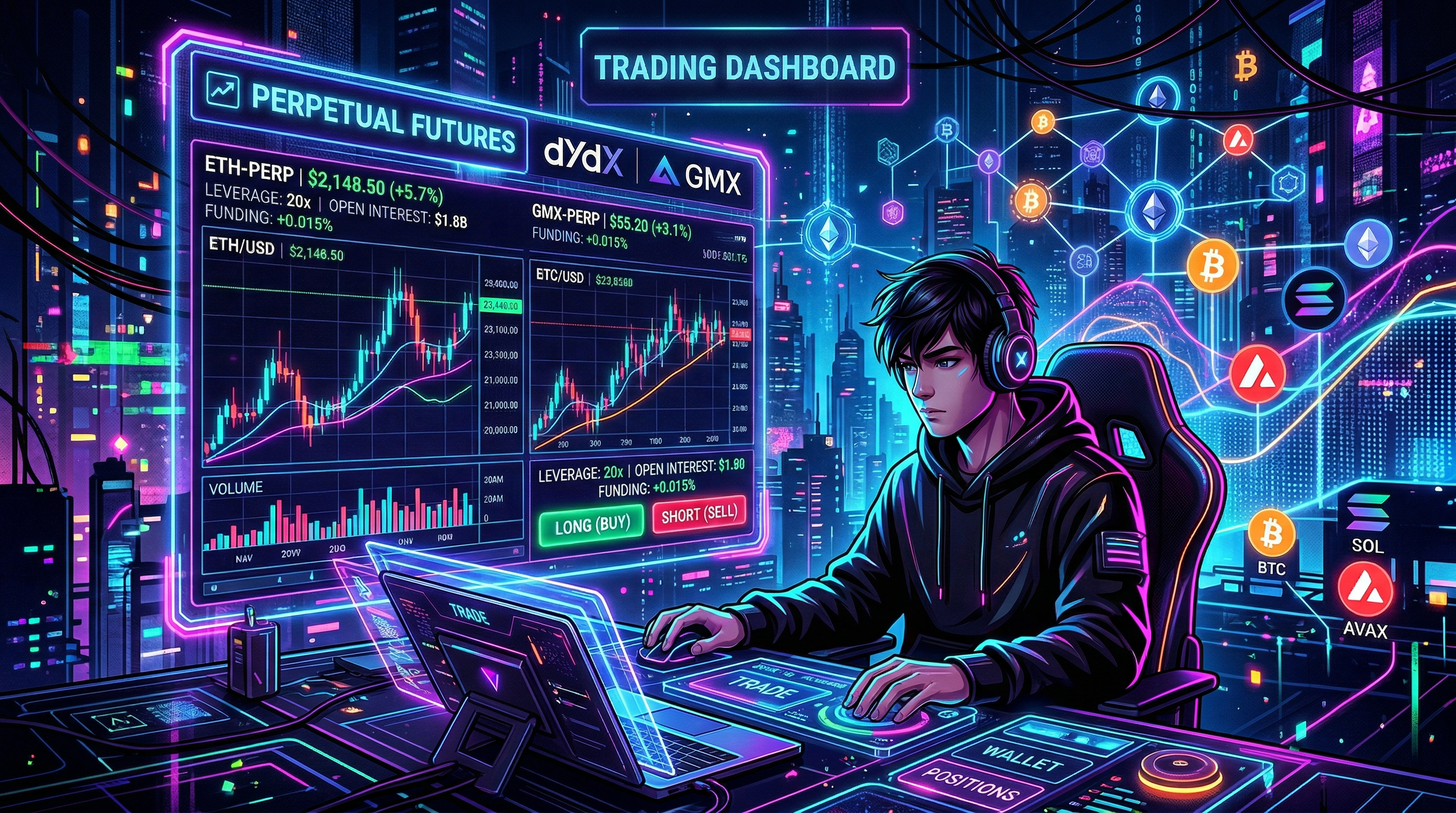
In September 2025, I turned $45,000 into $180,000 trading perpetual futures on GMX v2 and dYdX v4. Over the next three months, I turned $180,000 back down to $67,000. This is not a flex or a cautionary tale — it's a data set. And the data tells a very specific story about how perp trading works, who wins, and why 90% of retail perp traders lose money despite the obvious appeal of leveraged crypto exposure. Here's the complete breakdown of perps: how they work, where to trade them, and the mistakes I made so you don't have to.
Perpetual futures are the dominant trading product in crypto. They process over $200 billion in daily volume across all platforms — more than spot markets by a significant margin. Understanding them is essential if you're serious about crypto trading.
What Are Perpetual Futures? (The Non-BS Explanation)
A perpetual future ("perp") is a derivative contract that tracks an asset's price but never expires. Unlike traditional futures (which settle on a specific date), perps can be held indefinitely. You're not buying the actual asset — you're betting on its price direction with leverage.
How Funding Rates Keep Perps Pegged to Spot
Without an expiry date, how do perp prices stay close to spot? Funding rates. Every 8 hours (on most exchanges), the contract recalculates whether longs or shorts are paying each other. When more traders are long (bullish), funding is positive — longs pay shorts. When more traders are short, funding is negative — shorts pay longs. This payment mechanism keeps the perp price anchored to spot: if perp price rises above spot, funding goes positive, making longs expensive and encouraging arbitrageurs to short the perp and buy spot until prices reconverge.
Funding rates are one of the most important signals in crypto markets. Extremely positive funding (longs paying 0.1%+ per 8 hours = 109% annualized) signals overleveraged longs — a correction signal. Extremely negative funding signals overleveraged shorts — a potential short squeeze setup. Track funding rates on Traderise's market data before entering any leveraged position.
The single mistake that accounts for most retail perp losses: position sizing with too much leverage combined with too little margin buffer. At 10x leverage, a 10% price move against you wipes your entire position (liquidation). At 5x leverage, you need a 20% adverse move to get liquidated. Start with 3–5x max leverage until you fully understand your liquidation prices. Most professional traders rarely use more than 5–10x leverage even on their highest-conviction trades. The "100x leverage" features on exchange home pages are for casino degens, not profitable traders.
dYdX v4 vs GMX v2: Which Is Better for What?
dYdX v4 — The Orderbook Perp
dYdX v4 operates its own Cosmos-based blockchain (dYdX Chain) with a central limit order book (CLOB) — just like traditional futures exchanges. This gives traders the full experience of limit orders, stop-losses, and order book depth that they're used to from CEXes. Key stats in Q1 2026:
- Daily volume: $2–4 billion
- Supported assets: 50+ perpetuals
- Fees: 0.02–0.05% taker, rebates for makers
- Max leverage: 20x on major assets
Best for: Traders who want CEX-like UX with actual order books and self-custody. The trading interface is legitimately competitive with Binance's futures UI.
GMX v2 — The Liquidity Pool Perp
GMX v2 uses liquidity pools (GM pools) as the counterparty to traders. Instead of matching orders with other traders, you're trading against a pool of liquidity composed of ETH, BTC, USDC, and other assets. Liquidity providers earn fees from traders; traders benefit from deep liquidity and no spread in most conditions. Key stats:
- Daily volume: $400M–$1.5B (across Arbitrum + Avalanche)
- Assets: Major cryptos + some synthetics
- Fees: 0.05–0.1% position fee + funding
- Max leverage: 100x (but please don't)
Best for: Traders who want DeFi-native perps with a simpler interface, no orderbook complexity, and deep liquidity for larger positions.
Trade Crypto Smarter
Traderise gives you multi-asset access, real-time portfolio tracking, and low fees. Built for degens who want an edge.
Try Traderise FreeThe Other Perp Venues Worth Knowing
- Drift Protocol (Solana): The leading perp DEX on Solana. DLOB (Decentralized Limit Order Book) with a perpetual liquidity market maker. Fast, cheap, and increasingly liquid. Best for Solana-native traders.
- Hyperliquid: The fastest-growing perp DEX of 2025. Built its own app-specific blockchain with a fully on-chain order book processing 100K+ TPS. Volume rivals Binance futures on many days. HYPE token airdrop was one of the largest crypto airdrops in history.
- Vertex Protocol: Cross-margined perp DEX on Arbitrum combining spot + perp + money market in one interface. Unique for combining all trading types with shared margin.
The 5 Perp Trading Mistakes That Killed My $180K Position
- Averaging down into a losing leveraged position: When my $3,000 ETH long started losing, I added to it at $2,800 and $2,600. Instead of cutting the loss, I doubled my exposure. When ETH hit $2,400 and I got partially liquidated, the losses compounded. Never average down on leveraged positions.
- Ignoring funding rates: I held several long positions through periods of extremely positive funding rates (paying 0.08% per 8 hours). That's 35% annualized cost just to hold the position. I was losing money even when the price was flat.
- No hard stop-losses: Placing orders without pre-set stops is gambling. Every position should have a predetermined exit — both upside target and downside stop — set before you enter.
- Overconcentration in one direction: When I was up $135K, I had 85% of my account in simultaneous BTC and ETH longs with 8x leverage. One correlated move down wiped out months of gains in hours.
- Trading during extreme volatility without position reduction: FOMC announcement days, major protocol launches, geopolitical news — these events cause massive wicks that liquidate stops before recovering. Cut size or exit before known volatility events.
The Rules I Trade By Now
- Max 5x leverage on any single position
- No single position larger than 20% of account
- Always set a stop-loss before entering (non-negotiable)
- Check funding rates before opening — if above 0.05% per 8h, don't go long
- Track total account P&L weekly on Traderise alongside on-chain positions
- No trading 24 hours after a significant loss (emotional decision-making is statistically worse)
The degens who win at perp trading long-term aren't those who take the most risk — they're those with the most disciplined risk management. Manage your positions, track your performance, and always know your liquidation price before you enter any leveraged trade.
Trade Crypto With a Real Edge
Traderise gives you multi-asset crypto access, real-time market data, and the portfolio tracking you need to trade perps and spot intelligently. Stop flying blind.
Try Traderise Free