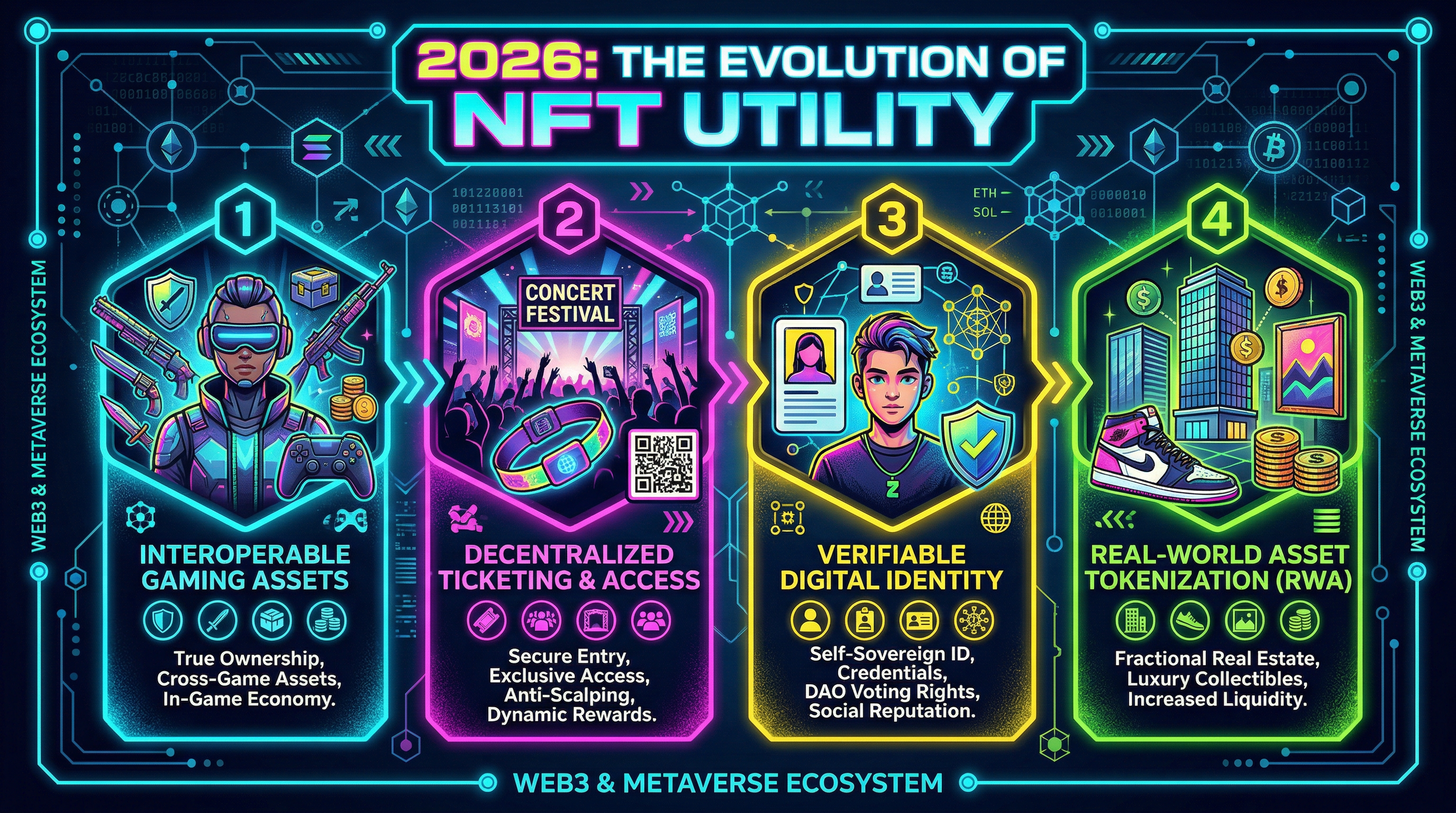
Every six months since 2022, the "NFTs are dead" tweet has gone viral. And every six months, the people writing those tweets are missing what's actually happening. The JPEG speculation market is genuinely dead — Bored Ape floor prices are down 92% from peak. But NFT infrastructure is now powering gaming economies with millions of daily active players, live event ticketing for major artists and sports leagues, and digital identity systems that Wall Street firms use for KYC. The technology didn't die. The speculation bubble did. These are very different things.
In Q1 2026, NFT trading volume crossed $800 million — not the $17B peak of 2022, but generating from actual utility rather than pure speculation. The protocols processing this volume are building towards $10B+ in annual utility-driven NFT activity by 2027. Here's the actual state of the NFT market and where the real opportunities are.
5 NFT Use Cases Generating Real Activity in 2026
1. Gaming Assets and In-Game Items
Web3 gaming has become the biggest driver of NFT volume that most people don't recognize as "NFT activity." Games like Parallel (card game on Base), Axie Infinity V3, and Illuvium have active secondary markets for in-game characters, items, and land parcels. The key insight: players buy and sell these items because they have genuine utility in gameplay — not because they're speculating on a JPEG.
Immutable X, a gaming-focused L2 on Ethereum, processes over 15 million NFT transactions monthly with near-zero gas fees. The $0.0001 per NFT mint cost via compressed NFTs on Solana has enabled game developers to mint equipment, achievements, and cosmetics as NFTs at scale that was economically impossible in 2021. This is the future of game asset ownership — players genuinely own their items and can trade them freely.
2. Event Ticketing
GET Protocol and POAP have processed over 40 million NFT tickets across 50,000+ events in 2025. Major use cases emerging:
- Anti-scalping: Smart contract rules can enforce max resale prices or require buyer identity verification, directly fighting ticket scalpers
- Dynamic tickets: Tickets that evolve — show your attendance history, unlock exclusive content, or upgrade your seat based on loyalty
- Programmable royalties: Artists earn a percentage every time a ticket is resold on secondary market — something impossible with Ticketmaster's traditional paper/PDF tickets
AEG Presents, one of the world's largest live entertainment companies, announced an NFT ticketing pilot for 500+ venues in 2025. We're past the proof-of-concept stage.
The compressed NFT innovation on Solana deserves more attention than it gets. Regular NFTs cost $5–50 to mint on Ethereum. Compressed NFTs on Solana cost $0.0001. Literally one ten-thousandth of a cent. This makes it economically viable to issue an NFT for every in-game action, every loyalty point, every social interaction. At that cost, NFTs become the accounting layer for digital ownership, not speculative collectibles. The mass adoption pathway runs through compressed NFTs.
3. Digital Identity and Credentials
Soulbound tokens (SBTs) — non-transferable NFTs — are becoming the standard for on-chain identity and credential systems. Real deployments in 2026:
- Worldcoin's World ID: An SBT proving you're a unique human (backed by iris biometric verification). Used by DeFi protocols, social platforms, and government pilot programs as a Sybil-resistance mechanism.
- GitPOAP: SBTs proving developer contribution history. Used by DAOs for governance weight and job candidates for on-chain portfolio verification.
- Galxe credentials: On-chain achievement credentials issued by protocols for completing specific actions. Used for airdrop eligibility, governance access, and reputation systems.
Trade Crypto Smarter
Traderise gives you multi-asset access, real-time portfolio tracking, and low fees. Built for degens who want an edge.
Try Traderise Free4. IP and Licensing
Story Protocol is building the IP layer for the internet — tokenizing intellectual property so that derivative works, licensing, and royalties can be tracked and enforced on-chain. The use case: a musician releases a song as an NFT. Producers who sample that song pay automated royalties in real time. Brands who use the IP pay licensing fees directly to the creator without middlemen. In Q1 2026, Story processed over $50 million in IP licensing transactions.
5. Real-World Asset Ownership
Circling back to RWAs — real estate, luxury goods, and fine art tokenization uses NFT standards (ERC-721 or ERC-1155) to represent fractional ownership. RealT's tokenized properties are technically NFTs. Wine and luxury watch tokenization platforms (Cult Wines, WatchIO) use NFTs to represent provenance and ownership for physical high-value items. The NFT is just the token standard — the underlying asset is the real thing.
What Happened to PFP NFTs? An Honest Autopsy
Bored Apes, CryptoPunks, Azuki, Pudgy Penguins — the profile picture NFT market never fully recovered from the 2022 crash. Floor prices are 70–95% below peak in ETH terms (even more in USD). Why?
- The collections had no intrinsic utility beyond community membership and speculation on resale value
- Oversupply: thousands of copycat collections launched during the 2021–2022 mania, diluting attention and capital
- Speculation requires new buyers; when the inflow of new buyers dried up in the bear market, prices had nothing to support them
- Many promises (metaverse experiences, token airdrops, games) were never delivered by project teams
Notable exception: Pudgy Penguins found genuine product-market fit by licensing IP to physical toy lines (sold in Walmart stores), creating an unusual feedback loop between physical products and digital collectibles. Their floor price has held relatively well compared to peers as a result.
Where to Look for NFT Opportunities in 2026
- Gaming NFT economies with active player bases: Look at daily active wallets, secondary market volume, and in-game utility — not floor price speculation
- NFT infrastructure tokens: MAGIC (TreasureDAO), IMX (Immutable X), GODS (Gods Unchained) — these capture value from gaming NFT activity without requiring you to pick specific NFT collections
- Ticketing platform tokens: GET Protocol, event POAP derivatives
- IP protocol tokens: Story Protocol's IP token is one of the more interesting 2026 narratives for NFT infrastructure
For tracking NFT infrastructure tokens and gaming tokens alongside your broader portfolio, Traderise lets you manage all your crypto assets in one place — no more switching between six different apps to track your holdings.
Trade NFT and Gaming Tokens With an Edge
Access NFT infrastructure tokens, gaming assets, and the full Web3 economy on Traderise. Real-time data, multi-asset access, and portfolio tracking built for degens.
Try Traderise Free