In November 2025, I almost threw $40,000 into a hyped-up DeFi governance token. I was deep in the FOMO spiral — Twitter was blowing up, the Discord was 100,000 members strong, the team had legitimate credentials, and the product was actually interesting. But I ran my tokenomics checklist first. What I found killed the trade instantly: 45% of tokens unlocking to VCs in 90 days, a $3.8B FDV at launch for a protocol with $12M in actual revenue, and a team allocation with no vesting cliff. The token launched, pumped 40%, then dumped 80%. I kept my $40K. Here's exactly how I did the analysis.
Most retail investors buy tokens based on narrative, price action, and social proof. The ones who consistently outperform run tokenomics analysis before buying anything. Tokenomics isn't sexy. But it's the difference between identifying genuine value creation and giving your money to VCs on the way out of their cliff.
The 7 Things You Must Check Before Buying Any Token
1. Fully Diluted Valuation (FDV) vs. Market Cap
Market cap = current circulating supply × current price. FDV = total max supply × current price. These two numbers can be wildly different. A token might show a "reasonable" $200M market cap, but if only 5% of tokens are circulating and the FDV is $4B, you're valuing the project at $4B when it's revenue might be $2M. When unlocks happen, the remaining 95% of supply enters circulation and the price gets crushed by the new supply.
Rule: FDV should never be more than 5-10x market cap at launch for a legitimate project. FDV 20x+ market cap is a massive red flag.
2. Vesting Schedules and Unlock Cliffs
Who holds the tokens and when can they sell? The key players to check:
- Team and advisors: Should have 1-year cliff (no tokens for the first year), then 3-4 year linear vesting. Any team with less than a 1-year cliff has weak commitment signals.
- Investors/VCs: Check the exact date and amount of each unlock. Project it on a chart. When you see a massive unlock cliff approaching, the market almost always prices it in negatively.
- Community/ecosystem: Should be the largest allocation (40%+). If team + investors control 60%+ of supply, it's not a decentralized project — it's a VC exit vehicle.
To find exact unlock schedules, check the project's whitepaper/documentation, TokenUnlocks.app, or Dune Analytics dashboards tracking token vesting contracts. Some projects obscure this information — if you can't find a clear, on-chain verifiable vesting schedule, treat the tokenomics as unknown. That's itself a red flag. Transparency is table stakes for any legitimate project in 2026.
3. Token Utility: What Is It Actually For?
Legitimate token utility tiers, from strongest to weakest:
- Fee capture + buy/burn: Token is used to pay fees, and a portion of fees are used to buy and burn tokens. Reduces supply, directly tied to protocol revenue. Strong.
- Staking for yield paid in protocol revenue: Token stakers receive a share of actual protocol revenue (real yield). Strong.
- Governance rights over meaningful treasury: Token holders vote on allocation of a large treasury with real assets. Medium strength — depends on governance quality.
- Governance rights over few actual decisions: Paper governance that doesn't control much. Weak.
- Access to features (paywall token): You must hold X tokens to use Y feature. Weak — anyone can just buy on demand, limiting price appreciation.
- Points/rewards/liquidity mining emissions only: No underlying utility, just used to incentivize behavior that benefits the protocol. Weakest — pure inflation.
Trade Crypto Smarter
Traderise gives you multi-asset access, real-time portfolio tracking, and low fees. Built for degens who want an edge.
Try Traderise Free4. Token Emission Rate and Inflation
How many new tokens are entering circulation each year? High emission rates create sell pressure as stakers and farmers dump their rewards. For any yield-generating token position, calculate: "Am I earning more % yield than the token's annual inflation rate?" If the token emits 50% more supply annually and you're earning 30% APY in that token, you're actually losing purchasing power.
Check: annual inflation rate on CoinGecko/Messari, current staking yield vs. inflation, team's plans to reduce emissions over time (emission halvings, demand-driven emission models).
5. Revenue vs. Valuation (P/E Ratio for DeFi)
DeFi protocols have real revenue — trading fees, interest paid by borrowers, liquidation fees. DefiLlama's "Fees" and "Revenue" sections show protocol-level revenue for all major DeFi projects. The key metric: Price/Earnings ratio (P/E). For a DeFi protocol: FDV / annual protocol revenue.
Examples in Q1 2026: Uniswap has an FDV of ~$9B and generates ~$1.2B in fees annually (P/E ~7.5). Aave FDV ~$4B, annual revenue ~$120M (P/E ~33). New protocols launching at 500x+ P/E multiples have no fundamental support for their valuation.
6. Token Distribution Concentration
How many wallets hold what percentage of supply? Check Etherscan's "Holders" tab for ERC-20 tokens. Red flags: top 10 wallets hold 50%+ of circulating supply (excluding contract addresses). A handful of whales can coordinate a price pump-and-dump, or a single large holder liquidating destroys the market.
7. Treasury and Runway
How long can the team fund development if the token price drops 80%? Projects that hold their treasury entirely in their own token are one bear market away from bankruptcy. Healthy treasuries have 2+ years of runway in stablecoins or ETH at current burn rates. OpenOrgs.info tracks many DAO treasuries publicly.
The Tokenomics Red Flag Checklist
Before any token purchase, run through these:
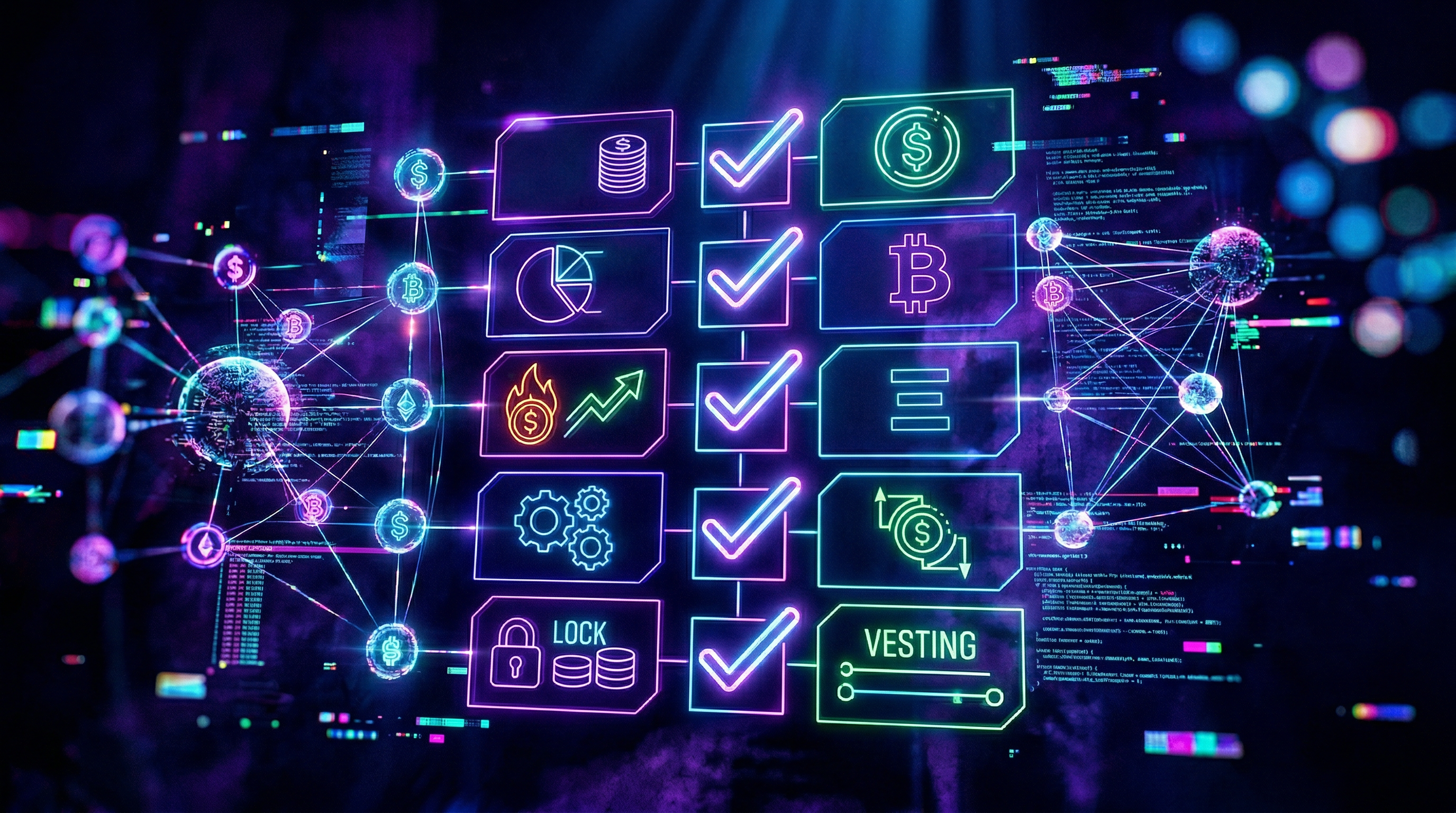
- ☐ FDV less than 10x market cap
- ☐ Team has 1+ year vesting cliff
- ☐ Investors hold less than 30% of total supply
- ☐ Community/ecosystem allocation is largest portion (40%+)
- ☐ Token has genuine utility beyond governance optics
- ☐ Annual emission rate under 20%
- ☐ Protocol has real revenue relative to valuation
- ☐ No major unlock cliffs in next 6 months
- ☐ Vesting schedule is on-chain verifiable
- ☐ Treasury has 18+ months stablecoin/ETH runway
When you do decide to buy, track your entries and portfolio performance across tokens on Traderise's multi-asset dashboard. Knowing your cost basis and real-time P&L on every position helps you make data-driven decisions about when to take profits or cut losses.
Real Example: How I Analyzed a 2026 Protocol Launch
Without naming names (for legal reasons), here's a real analysis template I ran in Q1 2026 on a new yield optimization protocol:
Launch price $0.85 → Market cap $68M → FDV $850M (10x multiple — acceptable). Team allocation 15% with 1-year cliff + 3-year vesting (good). Investor allocation 20% with 6-month cliff (mediocre — check unlock dates). Community 65% (strong). Annual emission 35% (high — calculate if yield compensates). Protocol revenue trailing $4.5M annually at launch → P/E ~189 at FDV (very expensive, requires significant growth). Treasury: $12M USDC, $8M ETH → ~18 months runway (acceptable). Top 10 holders: 38% (including team lockups) — acceptable once you strip out the locked team wallets.
Verdict: Expensive on fundamentals but acceptable structure. Position sized at 2% of portfolio with a clear exit plan at VC unlock dates. This is how you trade tokenomics, not just narratives.
Trade Tokens With Real Data, Not Just Hype
Access real-time price data, portfolio tracking, and multi-asset crypto trading on Traderise. Make tokenomics-informed decisions and track your positions precisely.
Try Traderise Free