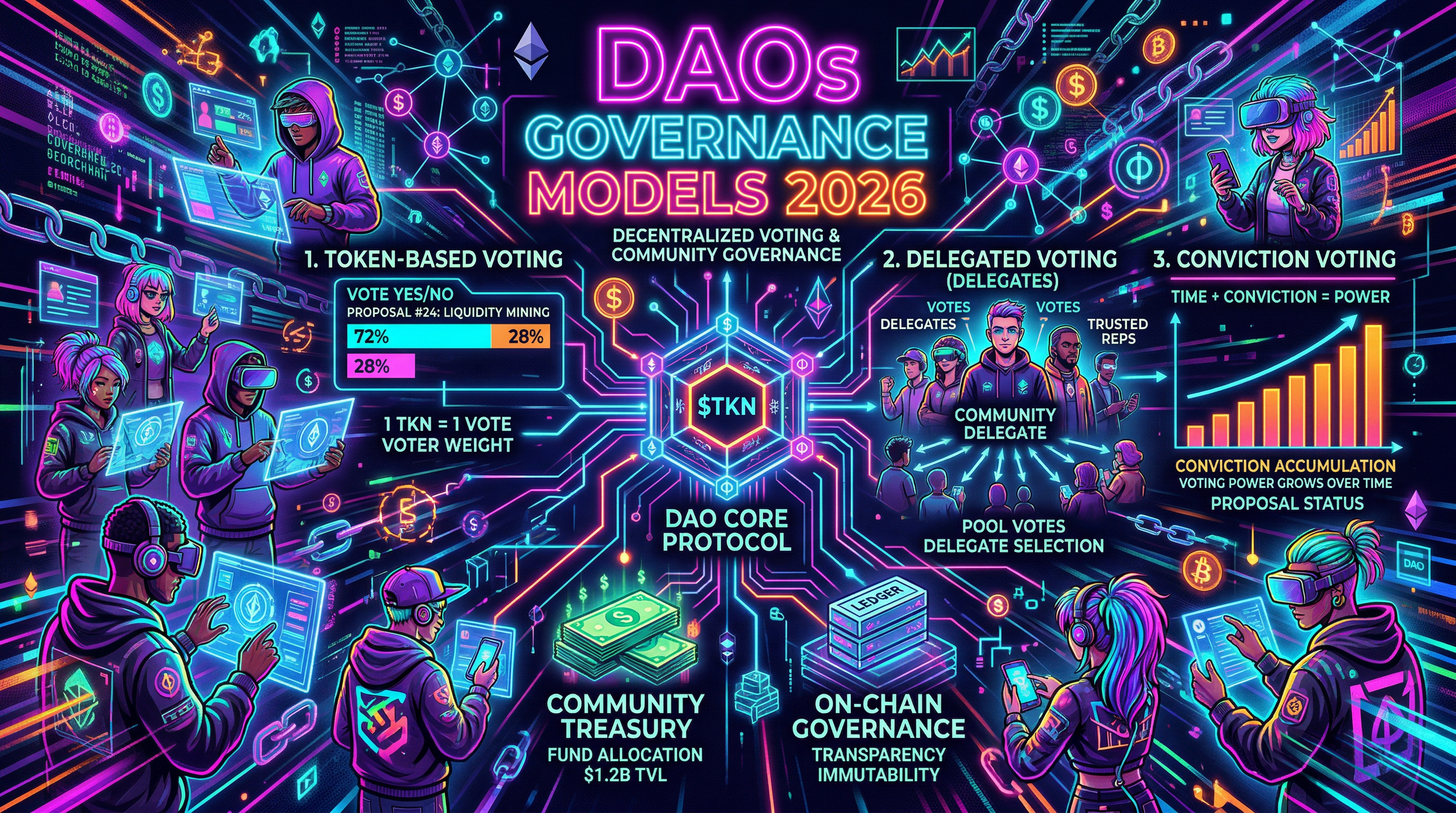
In 2022, ConstitutionDAO raised $47 million from 17,000 people to buy the US Constitution at auction. They lost the auction. The DAO's post-failure governance became a catastrophe — token holders voted to dissolve with no clear mechanism for returning funds, and the refund process was plagued by gas costs exceeding refund amounts for small holders. This is the dark comedy of early DAO governance: brilliant for capital aggregation, disastrous for actual governance. But in 2026, after years of painful iteration, several DAO governance models are genuinely working. Here's the honest state of the space.
DAOs (Decentralized Autonomous Organizations) are one of the most genuinely novel organizational forms in history. The idea: replace management hierarchies with code-enforced rules and token-weighted voting. In practice, early DAOs proved that "decentralized" ≠ "functional." But the surviving protocols have evolved sophisticated governance systems that handle billions in treasury management and protocol upgrades without catastrophic failures.
The 3 Main Problems Early DAOs Failed to Solve
1. Voter Apathy
Token-weighted voting sounds democratic. In practice, most token holders don't vote. Uniswap governance regularly sees less than 5% of UNI supply participating in votes. This means a small number of engaged whales or the VC funds holding large token positions effectively control governance outcomes. The "decentralized" label obscures what is functionally oligarchic control.
2. Plutocracy (Wealth = Votes)
In most token-voting systems, 1 token = 1 vote. This means those with the most capital have the most power. This is technically worse than traditional corporate governance, where at least regulations prevent the most egregious self-dealing. Several DAOs have been captured by whale coalitions who voted to benefit their own positions at the expense of smaller holders.
3. Speed vs. Security Tradeoff
Effective governance requires rapid response to market events. But on-chain voting takes days or weeks, requires quorum, and is irreversible once executed. When a DeFi protocol needs to respond to an exploit in hours, a governance process requiring a 5-day voting period is useless. This has led to "emergency multisigs" that bypass governance — which re-introduces the centralization that DAOs were supposed to eliminate.
The most dangerous DAO governance attack of 2025 was the "governance buyout" — an attacker accumulated enough governance tokens to pass a proposal draining the treasury, executing through valid governance mechanisms. This happened to Build Finance DAO ($470K drained), Tornado Cash DAO ($1M seized), and several smaller DAOs. The defense: large timelocks on all treasury-affecting proposals (give community time to react), minimum voting periods that can't be bypassed, and treasury distribution mechanisms that don't allow single-transaction drains.
5 DAO Governance Models That Are Actually Working
1. Optimistic Governance (Uniswap, Compound)
Proposals pass unless they receive sufficient "no" votes within a defined window. This flips the default: instead of requiring active mobilization for "yes," it assumes proposals pass unless there's significant opposition. Reduces voter fatigue by only requiring engagement for controversial decisions. Uniswap's "temperature check → consensus check → governance vote" three-step process has successfully handled multi-billion dollar treasury decisions.
2. veToken Governance (Curve Finance, Velodrome)
Vote-escrowed tokens: lock your CRV/VELO for 1–4 years to receive veCRV/veVELO with time-weighted voting power. The longer you lock, the more voting power you get. This aligns governance incentives with long-term protocol health — long-term lockers have the most power, short-term traders have little. The "Curve Wars" created a meta-ecosystem of protocols buying veCRV voting power to direct liquidity incentives. Weird, but effective at concentrating governance attention among long-term-aligned participants.
3. Delegated Governance (Compound, ENS, Gitcoin)
Token holders delegate their voting power to expert delegates who engage in governance on their behalf. This concentrates active participation among a smaller set of informed participants without requiring every holder to vote on every proposal. Compound's delegate system has worked reasonably well — recognized community members with track records of thoughtful participation attract significant delegation.
Trade Crypto Smarter
Traderise gives you multi-asset access, real-time portfolio tracking, and low fees. Built for degens who want an edge.
Try Traderise Free4. Rage Quit Mechanisms (Moloch-style DAOs)
Borrowed from Moloch DAO's design: members who disagree with a governance outcome can "rage quit" — exit the DAO with their proportional share of the treasury before the disputed action executes. This provides a minority protection mechanism that standard corporate governance lacks. MetaCartel Ventures, PartyDAO, and other investment DAOs use Moloch-style governance. The mechanism creates a natural governance limit: decisions that would cause mass rage quits (draining the treasury) are impossible to execute through governance because members can exit before the action executes.
5. Hybrid On-Chain/Off-Chain (MakerDAO/Sky, Aave)
The most mature DeFi protocols use off-chain signaling (Snapshot votes, forum discussions) for low-stakes decisions and on-chain governance (Tally, Governor Bravo) only for high-stakes protocol changes that require binding execution. This reduces gas costs for governance participation while maintaining on-chain execution for critical decisions. MakerDAO's governance has successfully managed a $10B+ protocol through multiple market cycles using this hybrid approach.
The Future of DAO Governance: What's Coming in 2026-2027
Three emerging governance innovations worth tracking:
- ZK-based voting: Privacy-preserving governance votes using zero-knowledge proofs. Vote without revealing your identity or position — prevents targeted coercion and vote-buying.
- AI-assisted governance: AI agents that analyze proposals for safety, precedent, and alignment with stated protocol goals. Several DAOs are experimenting with AI "constitutional advisors" that flag proposals violating protocol principles.
- Prediction market governance: Using prediction markets to assess whether governance proposals will achieve their stated goals, adding a market mechanism for evaluating proposal quality beyond simple voting.
For traders interested in DAO governance tokens as investments, the key metric is: does governance control a large, productive treasury AND does the token accrue value from protocol activity? Uniswap's governance controls $4B+ in treasury but UNI hasn't had a fee switch activated. Curve's governance controls real veCRV fee revenues. Track your DAO governance token portfolio on Traderise alongside the rest of your holdings.
Trade Governance Tokens That Actually Matter
Access Uniswap, Compound, Curve, and the full governance token ecosystem on Traderise. Real-time data and portfolio tracking for the degen who understands protocol value.
Try Traderise Free