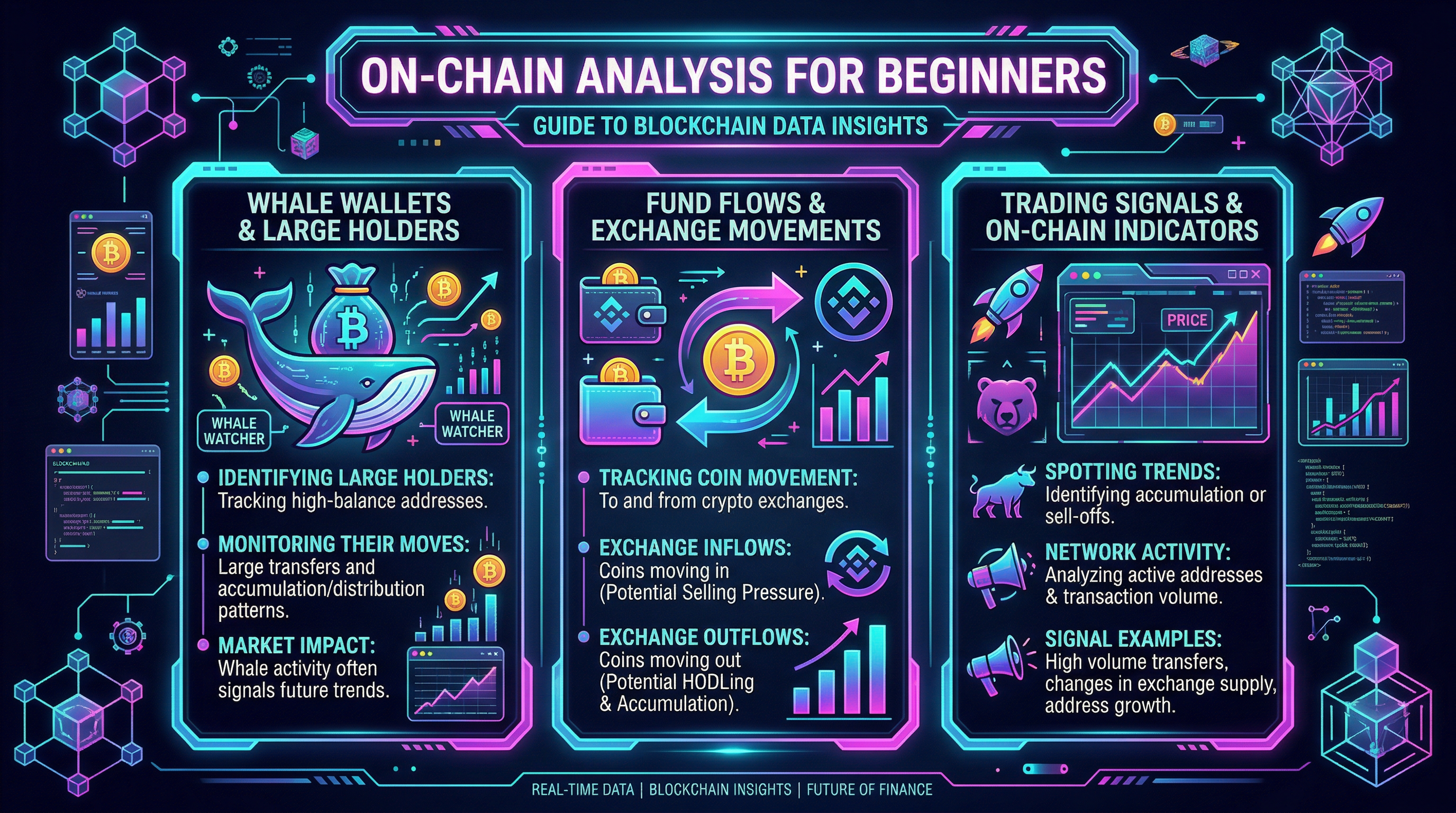
On January 8th, 2026, on-chain data showed 14 wallets identified as likely institutional accumulation addresses collectively added 22,000 BTC in a 72-hour window. Bitcoin's price at the time: $74,200. Twenty-three days later, BTC hit $101,000. I documented this accumulation event in real time using free on-chain tools that anyone can access. Here's the exact methodology — and the tools you need to start reading the blockchain like a whale.
On-chain analysis is the closest thing crypto has to "knowing the trade before it happens." You can't read fund managers' emails, but you can watch their wallets move. The blockchain is a 24/7 transparent ledger of every significant financial move made on-chain. Learning to read it is one of the highest-leverage skills in crypto. Here's how to start.
The Basics: What On-Chain Data Actually Tells You
Every transaction on a public blockchain — Bitcoin, Ethereum, Solana — is permanently recorded and publicly visible. You can see:
- How much ETH/BTC is held at any address
- Every transaction that address has ever made
- Whether funds are moving onto exchanges (potential sell signal) or off exchanges into cold storage (potential hold signal)
- How long an address has been holding specific assets (HODL waves)
- Funding rates and open interest on perp exchanges
- New address creation rate (a proxy for retail adoption growth)
The challenge: raw blockchain data is noise. On-chain analysis is the art of extracting meaningful signals from that noise. Here are the most reliable signals.
The 5 Most Reliable On-Chain Signals
1. Exchange Net Flow (The Most Important Signal)
When BTC moves from cold wallets onto exchanges (positive exchange inflow), holders are preparing to sell. When BTC moves from exchanges into cold storage (negative exchange flow / outflow), holders are taking it off the market. Large exchange outflows are bullish — reduced available sell-side supply. Large exchange inflows are bearish — increased available sell-side supply.
The January 2026 accumulation event I mentioned was identified by watching exchange outflows on Glassnode: the equivalent of 22,000 BTC left known exchange addresses over 72 hours. That's $1.6B worth of Bitcoin being moved into cold storage during what turned out to be a local price bottom. Correlation is not causation — but these patterns appear consistently enough to use as a signal.
Arkham Intelligence (ARKM token) has built the most comprehensive blockchain address labeling database available. They've identified thousands of exchange, fund, DAO, and institutional addresses. Their "intelligence" feature lets you track specific entities (a16z's crypto wallet, jump trading, specific protocols) in real time. If you're serious about on-chain analysis, Arkham is one of the most powerful free tools available. Also track their on-chain alerts alongside your trading on Traderise.
2. Long-Term vs. Short-Term Holder Supply
Glassnode classifies BTC wallets as "Long-Term Holders" (LTH — held 155+ days) or "Short-Term Holders" (STH — held under 155 days). When LTH supply is high and rising, most BTC is in the hands of conviction holders who've survived at least one bear market. When LTH supply declines, older holders are distributing to new buyers (often a bull market peak signal). The LTH supply indicator has flagged every major market top with a 2–6 week lead time over the past 5 cycles.
3. NUPL (Net Unrealized Profit/Loss)
NUPL measures the ratio of unrealized profit to unrealized loss across all BTC holders. When NUPL is extremely high (Euphoria zone), most holders are in massive profit and the probability of profit-taking increases. When NUPL is very low or negative (Capitulation zone), most holders are underwater and the probability of further selling is lower. Historical NUPL extremes have reliably identified market tops and bottoms. Available free on Glassnode's limited tier.
4. Funding Rates on Perpetual Futures
Perp funding rates measure the cost of holding a leveraged position. Positive funding: longs pay shorts — too many leveraged longs, market is overheated. Negative funding: shorts pay longs — market is oversold with excess shorting. Extreme positive funding often precedes corrections. Extreme negative funding often precedes short squeezes. Track aggregate funding rates across Binance, Bybit, and dYdX for the most reliable signal.
5. Miner Position Index (MPI)
Bitcoin miners are forced sellers — they receive BTC as block rewards and must sell periodically to cover electricity and operations costs. When MPI is high, miners are selling more than their historical average (bearish). When MPI is low, miners are holding/accumulating (bullish). Watching MPI alongside price action gives you insight into one of the most consistent sell-side pressure sources in Bitcoin.
Trade Crypto Smarter
Traderise gives you multi-asset access, real-time portfolio tracking, and low fees. Built for degens who want an edge.
Try Traderise FreeFree On-Chain Analysis Tools in 2026
Glassnode (Free Tier)
The gold standard for on-chain metrics. Free tier gives you access to exchange flow, active addresses, supply dynamics, SOPR (Spent Output Profit Ratio), and dozens of other signals updated daily. The paid tier ($29–$799/month) unlocks intraday data and premium indicators. For most retail on-chain analysts, the free tier is sufficient.
Dune Analytics
Community-built SQL dashboards querying raw blockchain data. The best on-chain research in crypto is often published as Dune dashboards. Ethereum-specific data (DeFi flows, stablecoin supply, protocol revenue) is better covered here than anywhere else. Free to use and browse; paid tier for faster query execution.
Nansen
On-chain data with wallet labeling. Nansen's "Smart Money" feature tracks what labeled whale wallets and funds are buying and selling. "Token God Mode" shows token-level holder analytics. Paid subscription ($150/month+) but worth it if you're making serious trading decisions based on on-chain data.
Arkham Intelligence (Free)
Entity-based on-chain data. Arkham has identified thousands of specific wallets (funds, exchanges, protocols, individuals) and lets you track their activity. Completely free with good coverage of major entities. The ARKM token incentivizes users to submit wallet labels, creating a crowd-sourced intelligence layer.
CryptoQuant
Bitcoin-focused on-chain data with strong exchange flow metrics. Good free tier for BTC analysis. Their "All Exchange Reserve" chart (total BTC held across all exchanges) is one of the most useful single charts for macro Bitcoin analysis.
A Simple 3-Step On-Chain Check Before Any Trade
- Check exchange flows: Is the asset flowing onto exchanges (potential sell pressure) or off (potential accumulation)? Large directional flows in the past 48 hours matter most.
- Check funding rates: Are perpetual funding rates positive (overleveraged longs — caution) or negative (overleveraged shorts — potential squeeze)?
- Check whale wallet activity: Have any labeled whale wallets or known funds been moving the asset in the past 7 days? Accumulation by smart money is a confirming signal; distribution is a warning.
Once you've done your on-chain homework, execute your trades on Traderise — set alerts for price targets, track your entries and exits precisely, and manage your full portfolio in one place. On-chain analysis tells you when to move; having the right trading infrastructure means you can actually execute when the signal hits.
Act on On-Chain Signals Instantly
When the whale wallets move, you need to execute fast. Traderise gives you instant access to crypto markets, real-time alerts, and portfolio tracking to capitalize on on-chain intelligence.
Try Traderise Free