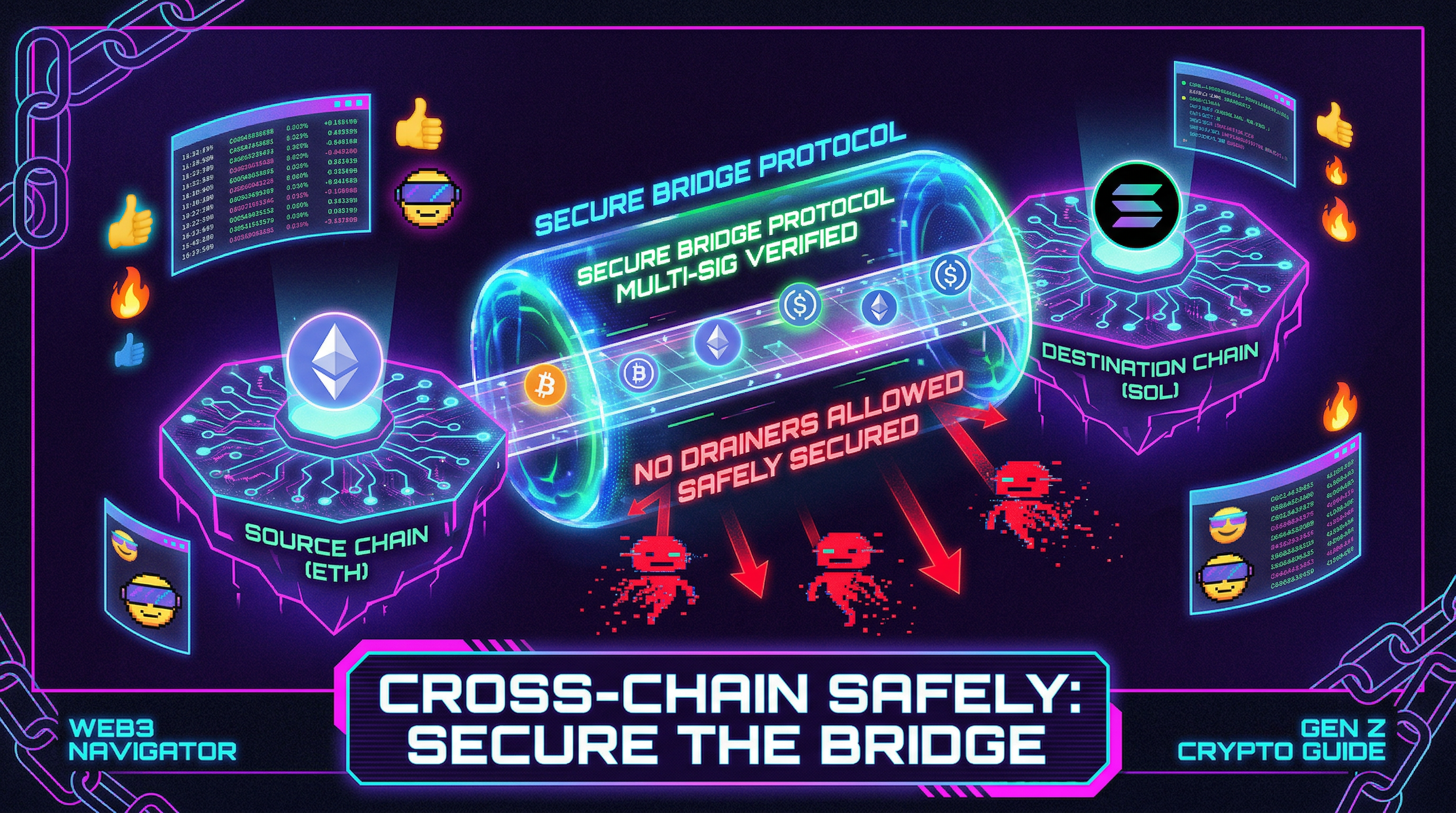
In March 2026, a popular cross-chain bridge exploit drained $2.1 million from unsuspecting users in under 4 minutes. The victims weren't rookies — they were experienced DeFi users who did everything "right" except check one critical detail. I tracked the exploit on-chain in real time, and what I found should change how every degen thinks about bridging. Here's the full breakdown — and the 7-step safety checklist I now run before every bridge transaction.
Cross-chain bridging has become one of the highest-risk activities in crypto. Since 2021, bridge exploits have drained over $3.4 billion in total. The Ronin Bridge ($625M), Wormhole ($320M), Nomad ($190M), Harmony Horizon ($100M) — bridges are consistently the biggest hack targets in DeFi. If you're bridging without understanding the risks, you're gambling.
Why Bridges Are the #1 Target for Hackers
Bridge smart contracts hold enormous amounts of assets locked up in one place. To bridge 10 ETH from Ethereum to Arbitrum, the bridge contract on Ethereum locks your 10 ETH and mints 10 "bridged ETH" on Arbitrum. That locked ETH is sitting in a smart contract — often worth billions of dollars — making it an irresistible target. One vulnerability in the contract logic or the message-passing layer can drain the entire vault.
The Three Main Bridge Architectures (And Their Risk Profiles)
Lock-and-Mint (Native Bridges): The canonical bridge architecture. Lock asset on chain A, mint wrapped version on chain B. Used by Arbitrum Bridge, Base Bridge, Optimism Gateway. Most secure because they inherit Ethereum's security model for L2s, but slow — the 7-day fraud proof challenge period means you wait a week for L2 → L1 withdrawals.
Liquidity Networks (Third-Party Fast Bridges): Across Protocol, Hop Protocol, Stargate Finance. These use pools of pre-funded liquidity on each chain — instead of actually bridging your assets, a relayer fronts you the funds on the destination chain and reclaims their capital from the bridge pool. Much faster (minutes vs. days) but introduces relayer risk and smart contract risk on the liquidity pools.
External Validator Bridges: A set of external validators (not Ethereum validators) verify cross-chain messages. This is how Wormhole, Multichain, and Thorchain work. These are the highest-risk architecture because they introduce a new trust assumption — you're trusting the bridge's validator set rather than Ethereum's security. When Multichain's CEO went MIA in 2023 and the bridge was drained of $130M, it was an extreme example of what can go wrong when you trust a centralized validator set.
The safest bridges in 2026 are the native L2 bridges (Arbitrum, Base, Optimism) for large amounts — even though they're slow. For small amounts that you need to move quickly, Across Protocol has the best security track record among fast bridges. Never use a bridge you found through a Google ad or a Discord DM. I've seen multiple people get phished through fake bridge sites that look pixel-perfect identical to the real thing.
The 7-Step Bridge Safety Checklist
This is the actual checklist I run before every bridge transaction. Non-negotiable:
- Verify the URL directly: Type the bridge URL manually or use a saved bookmark. Never click a link from Discord, Twitter/X, or Google ads. Fake bridge sites are a top-5 crypto scam in 2026.
- Check the contract address on-chain: The legitimate bridge contract address should be listed in the protocol's official GitHub or docs. Compare it with what your wallet shows before signing.
- Review smart contract security audits: Every legitimate bridge has been audited. Check their docs for audit reports from firms like Trail of Bits, Certik, or Spearbit. If you can't find audit docs, do not use the bridge.
- Check TVL and recent activity on DeFiLlama: A bridge with $50M TVL that normally processes $500M suddenly showing $2M suggests a drain. Recent unusual activity is a red flag.
- Start with a small test transaction: For any bridge you haven't used before, send $20–$50 first. Wait for confirmation. Then send the full amount. The small test costs you $2–3 in fees and could save your entire position.
- Check if the protocol is paused or has active exploits: Follow bridge protocol Twitter/X accounts and check their Discord. When exploits happen, teams usually tweet immediately. Rekt.news and Defihack.xyz track active exploits in real time.
- Understand the withdrawal delay: Know before you bridge how long it takes to get your assets back. If you might need liquidity quickly, use a fast bridge — but accept the higher fees and risk profile.
Trade Crypto Smarter
Traderise gives you multi-asset access, real-time portfolio tracking, and low fees. Built for degens who want an edge.
Try Traderise FreeThe Top 5 Bridges Ranked by Safety in 2026
1. Arbitrum Native Bridge — Safest for Large ETH Amounts
No third-party trust assumption. Your ETH is secured by Ethereum's fraud proof system. Downside: 7-day withdrawal to L1. For moving large amounts of ETH or ERC-20s to Arbitrum permanently, this is the gold standard. Use the official bridge at bridge.arbitrum.io — bookmark it.
2. Base Bridge / OP Gateway — Same Safety Level as Arbitrum
Same OP Stack architecture, same 7-day withdrawal window, same Ethereum-anchored security. For moving to Base or Optimism for longer-term deployments, use the native bridge.
3. Across Protocol — Best Fast Bridge for Daily Use
Across has processed over $15 billion in volume with zero major exploits as of April 2026. Their architecture uses UMA's optimistic oracle for dispute resolution and has a robust set of liquidity providers. 15–30 minute bridging, fees of 0.05–0.3%, and a clean interface. My daily driver for quick L2 hops.
4. Stargate Finance (LayerZero)
Massive liquidity, supports 20+ chains, backed by LayerZero's cross-chain messaging. Some concerns about LayerZero's validator set centralization exist, but Stargate has maintained its security through multiple market cycles. Good for cross-chain stablecoin bridging specifically.
5. Hop Protocol — Reliable for Optimistic Rollup Bridging
Hop specializes in bridging between Ethereum and Optimistic Rollup chains (Arbitrum, Optimism, Base). Solid track record, uses bonded relayers who stake capital as collateral — if they try to submit invalid transfers, they lose their stake. Decentralized and battle-tested.
What Happens If a Bridge Gets Hacked While Your Assets Are In Transit?
This is the question nobody wants to think about but everyone should. If a bridge is exploited while your transaction is in flight — meaning the funds you sent have been locked in the exploit-vulnerable contract but you haven't received them on the destination chain — you are at risk of losing everything. Bridge hacks are not like bank fraud where there's insurance or reversal options. Blockchain transactions are irreversible.
What can you do? Honestly, not much in the moment. Your options are: (1) monitor the bridge team's response for any recovery mechanism (Wormhole was made whole by Jump Capital in 24 hours — unusual but it happened), (2) participate in any governance vote for compensation from protocol treasury funds, (3) write it off as a loss and learn from it.
Prevention is everything. Track bridge transaction history alongside your portfolio on Traderise so you always know which assets are in transit and have a clear record of your on-chain activity.
The MEV Tax: How Bridges Also Expose You to Sandwich Attacks
Beyond the exploit risk, bridging also exposes you to MEV (Maximal Extractable Value) on the swap side. Many bridges auto-swap tokens when crossing chains, and if that swap happens through a DEX without slippage protection, bots can sandwich your transaction — front-running your buy and back-running your sell to extract value. Always check if your bridge route includes any DEX swaps, and if so, set explicit slippage limits. Across Protocol routes directly without swaps on most paths; Stargate uses their own StableSwap pool which has much lower MEV exposure than using a general AMM.
Conclusion: Bridge Smart, Not Fast
The TLDR on bridge safety: for large amounts, always use native L2 bridges even though they're slow. For quick moves, Across Protocol is the current gold standard for security-to-convenience ratio. Never use a bridge you found through an ad or DM. Always test with a small amount first. And follow bridge protocols on socials so you hear about exploits in real time instead of discovering one after the fact.
Managing multi-chain portfolios is easier on Traderise — track your assets across all chains, set alerts for unusual price movements, and keep your crypto strategy organized in one place.
Manage Your Crypto Safely
Multi-chain portfolio tracking, real-time alerts, and secure crypto trading — all on Traderise. Know where every dollar is at all times.
Try Traderise Free