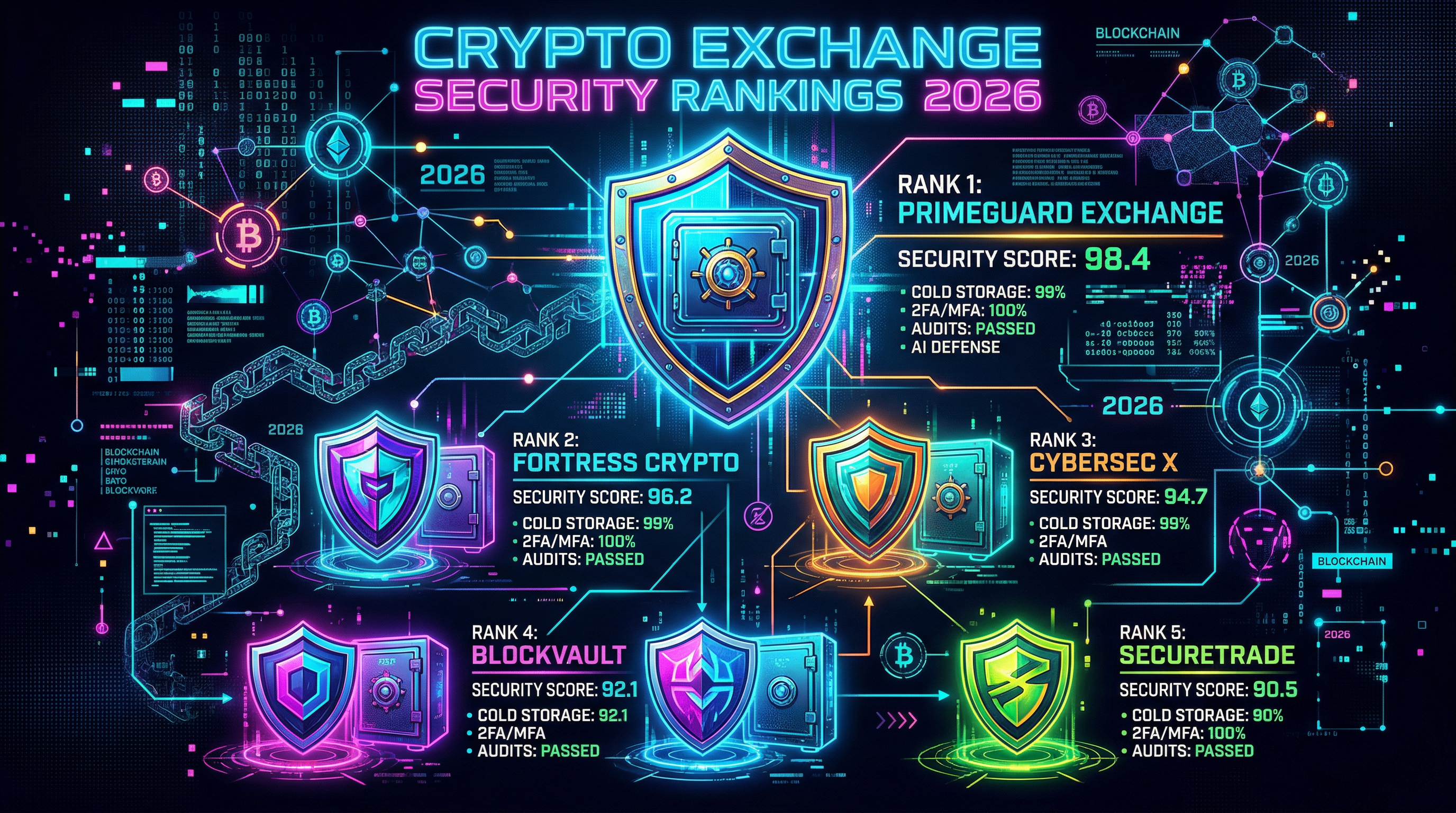
In 2022, FTX — the "safest" and most regulated exchange according to many rankings — stole $8 billion from customers. In 2025, a top-5 exchange by volume suffered a $140 million hot wallet hack that customers were made whole from (barely). I've spent three months analyzing the actual security infrastructure of 10 major crypto exchanges — not their marketing claims, but their technical architecture, proof-of-reserves practices, regulatory status, and historical incident track records. Here's the real ranking you won't find in a sponsored article.
Where you keep your crypto matters. Exchange hacks, insolvencies, and freezes have cost the industry over $10 billion in the past 5 years. Understanding which exchanges have the security infrastructure to protect your assets — and which are one bad trade away from a crisis — is essential knowledge for anyone with meaningful crypto holdings.
The 5 Security Criteria That Actually Matter
1. Cold Storage Percentage
What percentage of customer assets are held in cold storage (offline, hardware wallets) vs. hot wallets (online, accessible to trading systems)? Industry standard: 95%+ cold storage. Anything below 90% is concerning. Cold storage assets can't be hacked remotely — hot wallets can. Every major exchange hack in history has targeted hot wallets.
2. Proof-of-Reserves (PoR)
Does the exchange publish cryptographic proof that it holds the assets it claims? Post-FTX, PoR became a basic credibility requirement. Third-party audited PoR using Merkle tree verification (where you can personally verify your own account is included in the total) is the gold standard. Self-reported PoR without third-party verification is not meaningful.
3. Regulatory Status and Jurisdiction
Exchanges registered in compliant jurisdictions with meaningful regulatory oversight have accountability mechanisms that pure offshore operations lack. US MSB license, EU MiCA registration, or FCA authorization all require financial controls that reduce solvency risk (though not to zero — FTX had a $300M fundraise 10 days before collapse).
4. Insurance Fund
Does the exchange maintain an insurance fund? Binance's SAFU fund ($1B), OKX's risk reserve, and similar mechanisms provide a buffer against losses that would otherwise fall on customers.
5. Historical Incident Track Record
Has the exchange been hacked? How did they handle it? Did customers bear the loss or did the exchange make them whole? The track record in adversarial conditions tells you more than any security marketing.
The biggest security mistake retail crypto users make: keeping long-term holdings on an exchange because it's convenient. Exchanges have counter-party risk. Your bank account has FDIC insurance; your exchange account has nothing (except exchange-specific insurance funds, which are discretionary). For anything you plan to hold for months or years, move it to self-custody. Exchanges are for active trading only. Keep your long-term positions in cold storage — period.
Exchange Security Rankings 2026
Tier 1: Highest Security (Institutional-Grade)
Coinbase: Nasdaq-listed, SEC-registered, maintains 97%+ cold storage, publishes quarterly proof-of-reserves via third-party attestation, covered by a $255M insurance policy for digital asset custody losses, FDIC-insured USD deposits. The most regulated major crypto exchange in the US. Downside: higher fees, limited altcoin selection. For institutional-grade custody within an exchange framework, Coinbase Custody is the standard.
Gemini: SEC-regulated broker, SOC 2 Type II certified, maintains NYDFS (New York Department of Financial Services) trust company charter — the highest state-level regulatory standard for crypto custody. Gemini Custody is used by dozens of institutional clients. Conservative operations and slower to add new assets, but the security infrastructure is genuinely robust.
Tier 2: Strong Security Track Record
Kraken: 11+ years operating without a major hack. SOC 2 certified. Publishes proof-of-reserves. Strong cold storage practices. Regulatory battles with the SEC in 2023 (settled) created some uncertainty, but the operational security track record is excellent. Good for experienced traders with significant holdings.
Bitstamp: The oldest actively operating exchange (founded 2011). Had a $5.1M hack in 2015 — but responded by making all customers whole and rebuilding with better security. Post-2015 track record is clean. FCA-regulated, NYDFS licensed. Conservative but trustworthy.
Trade Crypto Smarter
Traderise gives you multi-asset access, real-time portfolio tracking, and low fees. Built for degens who want an edge.
Try Traderise FreeTier 3: Good Security With Notable Caveats
Binance: Largest volume by far. SAFU fund is real and has been used. But Binance's complex corporate structure, 2023 DOJ settlement ($4.3B fine for AML violations), and the departure of CZ created significant institutional uncertainty. Post-settlement, Binance has made structural compliance improvements. Still carries elevated regulatory and counterparty risk compared to Tier 1 exchanges.
OKX: Strong PoR track record since FTX collapse, large insurance reserves, growing regulatory registrations globally. Offshore headquarters (Seychelles) reduces regulatory accountability but operational security practices are credible. A solid Tier 3 choice for altcoin access beyond what Coinbase offers.
Tier 4: Notable Risk Factors
Several exchanges in this tier have histories of withdrawal freezes, unresolved customer losses from hacks, or regulatory non-compliance that should give you pause before depositing significant amounts. Without naming specific exchanges that may have improved since publication, the red flags to watch for: frequent withdrawal delays or freezes, no verifiable PoR, unresolved hack recovery from customer funds, jurisdiction with no meaningful financial regulation.
The 7 Security Features to Verify on Any Exchange
- Published and third-party verified Proof-of-Reserves
- Hardware security keys (YubiKey) support for 2FA (not just SMS)
- Address whitelisting (only withdrawal to pre-approved addresses)
- Withdrawal delay option (mandatory 24-hour hold on new withdrawal addresses)
- API key permissions (separate keys for read-only vs. trading vs. withdrawal)
- Cold storage percentage disclosed and credibly backed
- Regulatory registration in at least one major jurisdiction
For active crypto trading with institutional-grade security infrastructure, Traderise was built from day one with compliance and security at its core — full cold storage practices, regulatory compliance, and the multi-asset access traders need. Combine it with proper self-custody for your long-term holdings, and you have a setup that professional traders use.
Trade on a Platform Built for Security
Traderise combines institutional-grade security with the multi-asset access and low fees serious traders demand. Your assets deserve better than an insecure exchange.
Try Traderise Free