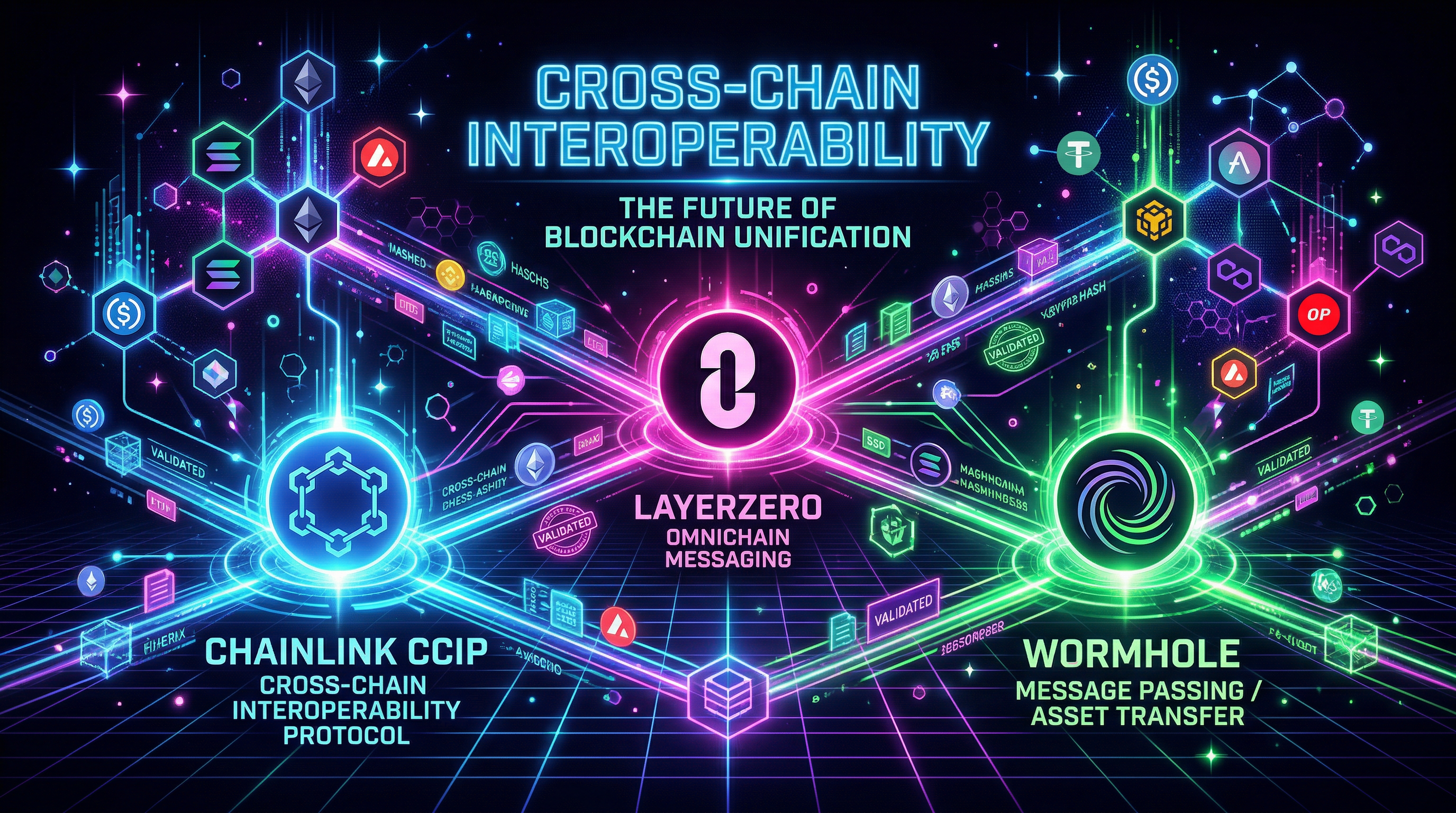
There are currently over 200 active blockchain networks. They can barely talk to each other. A token on Ethereum can't natively interact with a contract on Solana. An NFT on Polygon can't be used in a game on Avalanche without a bridge with its own security risks. This fragmentation is holding Web3 back — and three major protocols are racing to solve it, with billions in value and the architecture of the future internet at stake. Here's who's winning and why it matters more than most traders realize.
Cross-chain interoperability is not a niche technical problem — it's the fundamental infrastructure challenge of Web3. The protocol that becomes the dominant cross-chain messaging standard will capture enormous fee revenue from every asset transfer and cross-chain smart contract interaction. We're talking about a protocol with the network effects of TCP/IP — the invisible standard that everything runs on.
The Problem: Why Blockchains Can't Just "Talk" to Each Other
Each blockchain is a sovereign network with its own consensus mechanism, state, and execution environment. For Chain A to trust a message from Chain B, it needs to somehow verify that Chain B's state is what it claims to be. Without a shared security model, this requires either: (a) a trusted intermediary (centralized, defeats the purpose of crypto), or (b) a cryptographically secure message-passing layer (complex and expensive to build correctly).
The bridge hacks of 2022–2023 ($3.4B+ stolen) were largely attacks on early, insecure attempts at cross-chain communication. The protocols building in 2024–2026 are taking much more sophisticated approaches to this problem.
The "oracle problem" in cross-chain messaging: when Chain A needs to know what happened on Chain B, it needs a reliable source of truth. Chainlink CCIP uses Chainlink's decentralized oracle network for this — the same network that secures $20B+ in DeFi collateral pricing. This gives CCIP a security foundation that completely new networks lack. The trade-off: higher latency and cost than competitors. For high-value institutional transactions, this security premium is worth it.
Chainlink CCIP: The Institutional Standard
Chainlink Cross-Chain Interoperability Protocol (CCIP) is Chainlink's cross-chain messaging layer. Key design choices:
- Defense-in-depth security: Risk Management Network — an independent set of validators that can pause CCIP message delivery if anomalies are detected — sits on top of the primary messaging network
- Powered by existing Chainlink oracle infrastructure: Leverages the same battle-tested oracle network that Aave, Compound, and Synthetix rely on for price data
- Institutional focus: CCIP has been adopted by SWIFT (the bank messaging network) for cross-chain settlement pilots — a validation from traditional finance that no other cross-chain protocol has
CCIP launched live on mainnet in 2023 and has processed over $2B in cross-chain value with zero security incidents. The trade-off: more expensive than competitors (higher gas overhead per message), slower message delivery (minutes rather than seconds).
LayerZero: The Developer-First Cross-Chain Protocol
LayerZero is the most developer-adopted cross-chain messaging protocol in 2026. Over 50,000 applications are built on LayerZero's messaging infrastructure, including Stargate Finance (the largest bridge by volume), Radiant Capital, and dozens of major DeFi protocols.
LayerZero's architecture uses "Ultra Light Nodes" — rather than running a full light client for every chain, it uses on-chain endpoints and an oracle/relayer combination to pass messages. This makes it significantly cheaper and faster than heavier alternatives. ZRO token launched in 2024 after one of the most anticipated (and controversial) airdrops — many users felt the distribution criteria were unfair.
The security criticism: LayerZero's security relies on the assumption that the oracle and relayer are not colluding. The default oracle (Google Cloud) and default relayer (LayerZero Labs) being from the same ecosystem raises centralization concerns. Users can choose custom oracles/relayers (including Chainlink) for enhanced security, but the default option introduces a trust assumption.
Trade Crypto Smarter
Traderise gives you multi-asset access, real-time portfolio tracking, and low fees. Built for degens who want an edge.
Try Traderise FreeWormhole: The Solana-Ethereum Bridge That Survived Its Own Hack
Wormhole is the dominant cross-chain bridge for Solana-Ethereum interoperability and has expanded to 20+ chains. It processes hundreds of millions in daily cross-chain volume. Notable history: Wormhole was exploited for $320 million in February 2022 — one of the largest bridge hacks in history. Jump Crypto (a major investor) replenished the $320M overnight, preventing user losses. The protocol was rebuilt with significantly improved security.
Wormhole's "guardian" network is a set of 19 "guardians" (institutions including Jump, Certus One, and others) who must reach threshold consensus (13/19) to validate cross-chain messages. More decentralized than many bridge alternatives, but still relies on a relatively small and known validator set compared to Ethereum's 900,000+ validators.
The Other Protocols Worth Tracking
- Axelar Network: General message passing using its own proof-of-stake chain as the routing layer. Backs "ICS" (Interchain Standards) for Cosmos ecosystem chains.
- Hyperlane: Permissionless interoperability — any developer can deploy their own interchain messaging without permission from a centralized team. Modular security design.
- IBC (Inter-Blockchain Communication): The native Cosmos interoperability standard. Works beautifully within the Cosmos ecosystem (Cosmos, Osmosis, Celestia, etc.) but has limited reach outside.
The Investment Thesis: Which Cross-Chain Protocol Wins?
The honest answer: multiple protocols likely survive, each serving different segments. CCIP for institutional/high-value transfers. LayerZero for developer ecosystem and DeFi applications. Wormhole for Solana-heavy applications. IBC for Cosmos ecosystem.
The token investment thesis:
- LINK: Captures value from CCIP fees plus the existing oracle network. The most defensible moat. Institutional adoption of CCIP is a meaningful catalyst for LINK token value accrual.
- ZRO: Captures fee revenue from LayerZero's messaging volume. Currently very high transaction volume but token fee switch is not yet fully activated.
- W (Wormhole): Governance token with future fee capture potential. High risk — the airdrop created significant sell pressure and the token has struggled.
For tracking your cross-chain interoperability token positions, Traderise supports LINK, ZRO, W, and the full interoperability ecosystem with real-time price data and portfolio tracking.
Invest in the Infrastructure That Connects Web3
Trade Chainlink, LayerZero, Wormhole, and the full cross-chain ecosystem on Traderise. Get early to the protocols that will power the multichain internet.
Try Traderise Free