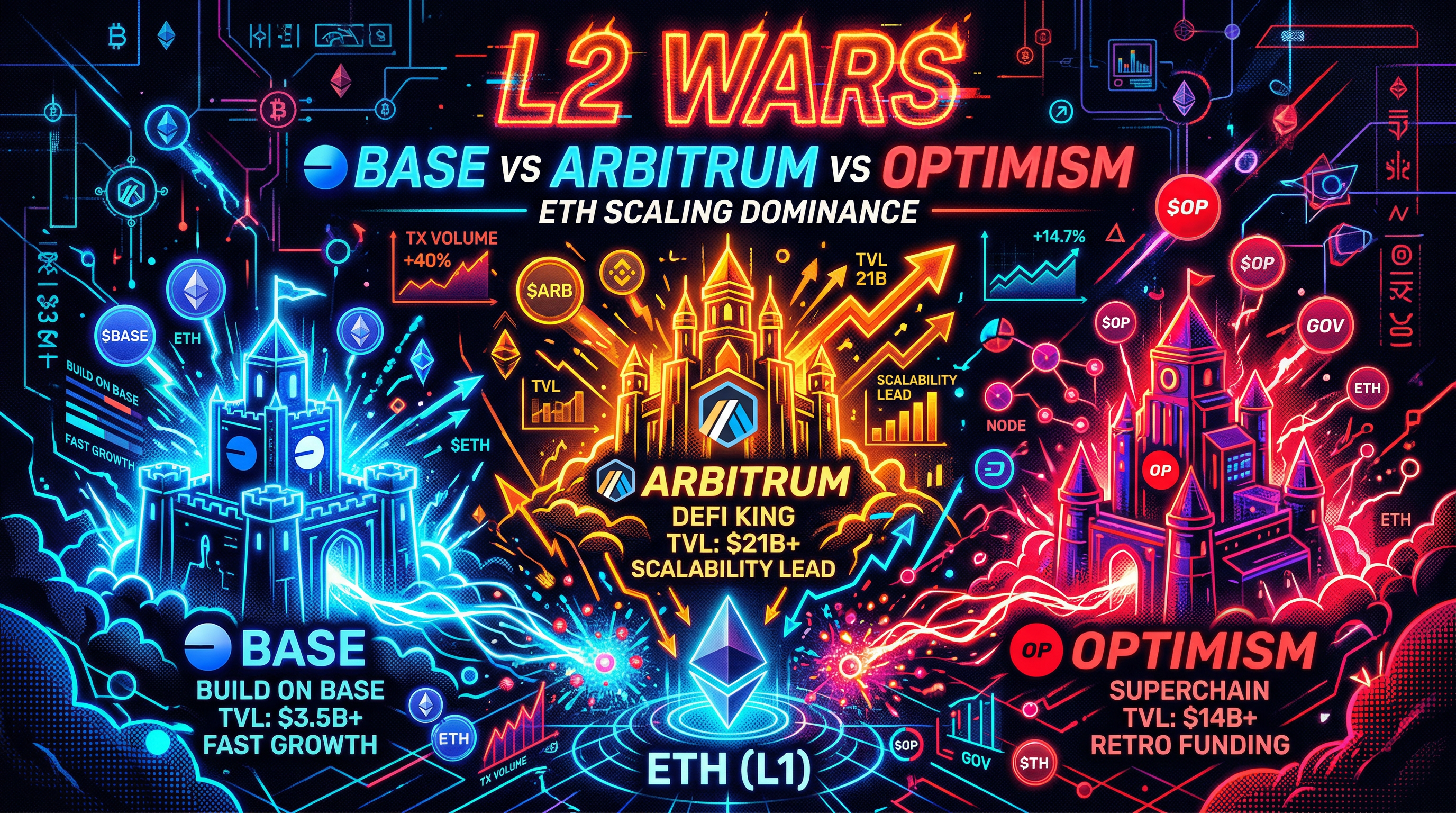
The L2 wars have a winner emerging and it's not who most people predicted. Base — Coinbase's L2 launched in August 2023 — has quietly become the dominant consumer crypto chain, processing over 4.5 million daily transactions in Q1 2026 and hosting some of the highest-traffic onchain social apps ever built. Meanwhile Arbitrum is fighting for DeFi TVL supremacy and Optimism is going full "superchain" with its OP Stack ecosystem. Here's who's winning, who's losing, and where smart degens should be deploying capital right now.
If you're still paying $5–$15 in gas on Ethereum L1 for every swap, you're not just losing money — you're operating in 2021. L2s have made onchain activity cheap enough that normal humans can afford to use DeFi. The question is: which L2 deserves your attention in 2026?
The Numbers: Where Are Users Actually Going?
Let's start with raw data, because opinions without data are just vibes:
- Base: ~4.5M daily transactions, ~$7.8B TVL, 650K+ daily active addresses (April 2026)
- Arbitrum One: ~2.8M daily transactions, ~$18.4B TVL, 380K daily active addresses
- Optimism Mainnet: ~1.1M daily transactions, ~$8.1B TVL, 190K daily active addresses
Arbitrum wins on TVL — it's where serious DeFi money lives (GMX, Camelot, Radiant). Base wins on user activity and social/consumer apps. Optimism has transformed into an infrastructure layer via the OP Stack, and its "raw" mainnet numbers understate its total ecosystem reach (OP Stack chains processed 12M+ daily transactions across the whole network).
Base's secret weapon isn't tech — it's Coinbase's 110 million+ verified users. When Coinbase adds a native "send to Base" button in their app (which they did in late 2024), they instantly onboard mainstream users to a crypto network without those users even knowing they're "using blockchain." That distribution flywheel is something Arbitrum and Optimism simply cannot replicate without a Coinbase-equivalent backing.
Speed and Fees: How Each L2 Actually Performs
Base: Consumer-Grade UX, Coinbase Sequencer
Base uses the OP Stack (same tech as Optimism) and currently runs a centralized Coinbase sequencer. Transaction finality: ~2 seconds. Fees: $0.001–$0.01 for most transactions. Post-EIP-4844 (proto-danksharding), Base fees dropped by 95%+ from pre-blob levels. The centralized sequencer is a valid criticism — Coinbase can theoretically censor transactions. Coinbase has committed to decentralizing the sequencer, but as of April 2026, they haven't done it yet. Track your Base portfolio positions on Traderise alongside your L1 holdings.
Arbitrum One: Optimistic with Fraud Proofs
Arbitrum uses its own custom Nitro technology (still Optimistic Rollup, but with a proprietary fraud proof system). Transaction finality: ~250ms for soft confirmation, 7-day withdrawal window back to L1. Fees: $0.01–$0.05 depending on L1 congestion. Arbitrum has delivered on progressive decentralization more than Base — its validator set is more distributed and it launched a governance token (ARB) with actual governance power. The DeFi ecosystem here is deeper: GMX v2, Camelot DEX, Pendle, Radiant Capital, and dozens of established protocols call Arbitrum home.
Optimism: The Superchain Vision
Optimism is playing a different game. Rather than competing head-to-head as a single chain, they've open-sourced the OP Stack and are building a "Superchain" — a network of interoperable L2s all sharing the same tech stack, sequencer standards, and eventually native cross-chain messaging. Chains in the OP Superchain include Base, OP Mainnet, Zora, Mode, Mint, and dozens more. The OP token accrues value from sequencer revenue across ALL these chains. It's a fundamentally different thesis from "be the best single L2."
Trade Crypto Smarter
Traderise gives you multi-asset access, real-time portfolio tracking, and low fees. Built for degens who want an edge.
Try Traderise FreeDeFi Ecosystems: Where Is the Real Yield?
Arbitrum DeFi: The Blue Chips Live Here
If you're a serious DeFi user, Arbitrum is where you need to be. GMX v2 processes hundreds of millions in daily perp volume. Pendle Finance's yield trading is genuinely innovative and Arbitrum is its primary chain. Camelot DEX has become the de facto Uniswap alternative for Arbitrum-native projects. The DeFi yield opportunities on Arbitrum are more mature, more liquid, and frankly more interesting than other L2s.
Base DeFi: Aerodrome and the Velodrome Fork Era
Aerodrome Finance — a Velodrome fork — has become the dominant DEX on Base with $2.4B+ TVL. Aerodrome's ve(3,3) tokenomics have made it the liquidity hub for the entire Base ecosystem. Morpho Blue launched on Base with significant TVL. The challenge: Base DeFi protocols are newer and less battle-tested than Arbitrum's ecosystem.
Optimism DeFi: Velodrome and Infrastructure Plays
Velodrome Finance, the original ve(3,3) DEX, is the largest protocol on OP Mainnet. Synthetix v3 has a significant presence here. The honest take: OP Mainnet's DeFi scene is solid but not exceptional — the real OP ecosystem play is understanding the Superchain thesis and positioning in OP token rather than chasing individual protocol yields.
Bridging Between L2s: The UX Problem Nobody Fixed Yet
Here's the dirty secret of the L2 ecosystem in 2026: moving assets between L2s still sucks. Native bridges (Arbitrum bridge, Base bridge) take 7 days for L2 → L1 withdrawals due to the fraud proof challenge period. Third-party bridges like Across, Stargate, and Hop Protocol offer fast bridging (minutes) but charge fees and introduce their own smart contract risk. The "one-click multichain" dream is still partially a lie. Until native fast withdrawal mechanisms are fully deployed, bridge UX remains a friction point that keeps users siloed on whichever chain they started on.
Token Thesis: ARB vs OP — Which Is the Better Bet?
This is the question everyone's actually asking. Here's my honest take:
- ARB: Controls a mature DeFi ecosystem with deep liquidity. The Arbitrum DAO has $3B+ in its treasury. ARB governance has real power over sequencer fees and ecosystem grants. The bull case is Arbitrum becoming the DeFi settlement layer for institutional flows. The bear case is that ARB doesn't capture enough protocol revenue to justify its FDV.
- OP: The Superchain thesis is genuinely exciting — if Base, OP, Zora, and all OP Stack chains eventually contribute sequencer fees to the OP treasury, the revenue accrual could be enormous. But the timeline is long and uncertain. You're betting on the superchain vision materializing, not just on OP Mainnet.
- BASE: There is no BASE token and Coinbase has not committed to creating one. Degen speculation about a Base airdrop has been going on for two years with no resolution. Don't buy anything claiming to be the "BASE token" — those are scams.
Which L2 Should You Actually Use in 2026?
The answer depends on what you're doing:
- Consumer apps, social, low-value NFT minting: Base. Cheapest fees, best UX, most user-friendly onramps.
- Serious DeFi (perps, yield, lending): Arbitrum. Deepest liquidity, most mature protocols, best tooling for power users.
- Infrastructure plays, long-term superchain thesis: OP ecosystem. Own OP token, use Velodrome, watch the Superchain development closely.
For managing positions across multiple L2s simultaneously, Traderise's multi-asset dashboard shows your full cross-chain portfolio in one view. When you're actively farming on Arbitrum, holding assets on Base, and tracking OP governance positions, having one place to see everything is non-negotiable.
Trade Across All L2 Ecosystems
Traderise gives you multi-asset crypto access, real-time portfolio tracking across chains, and the lowest fees for active traders. Stop managing 5 different apps.
Try Traderise Free